
When people talk about losing weight, they often focus on diets, workouts, or calorie counting. But what if the real obstacle isn’t your willpower-it’s your thoughts? Behavioral weight loss therapy, especially when rooted in cognitive behavioral therapy (CBT), doesn’t just tell you what to eat. It helps you change how you think about food, your body, and your progress. And for many, that shift makes all the difference.
Why thinking matters more than you think
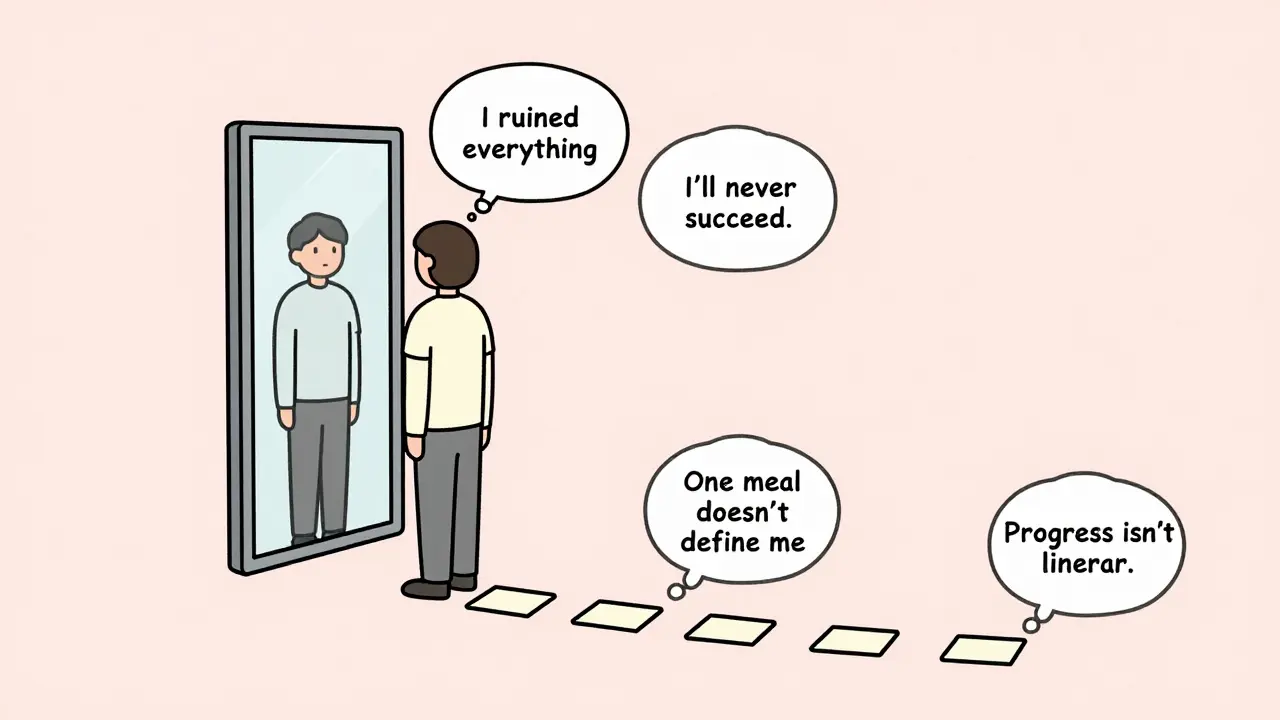
Think about this: You eat a slice of cake. Then you think, “I’ve ruined everything.” So you eat the whole tray. That’s not about hunger. That’s about a thought pattern-something called all-or-nothing thinking. It’s one of the most common mental traps in weight loss. You believe if you slip up once, you’ve failed completely. That mindset turns a small mistake into a full-blown relapse.
CBT for weight loss targets these exact patterns. It’s not magic. It’s not a new diet. It’s a set of proven tools built on decades of psychological research. Developed in the 1960s by Aaron Beck and later adapted for obesity in the 1980s, CBT now has solid evidence backing its use. A 2023 meta-analysis of 9 studies with over 900 participants showed that people using CBT lost an average of 1.6 BMI points more than those who didn’t. That’s not dramatic-but it’s consistent. And when combined with other strategies, the results get even stronger.
The 6 cognitive strategies that actually work
Not all CBT is the same. The most effective programs for weight loss use a mix of six core techniques:
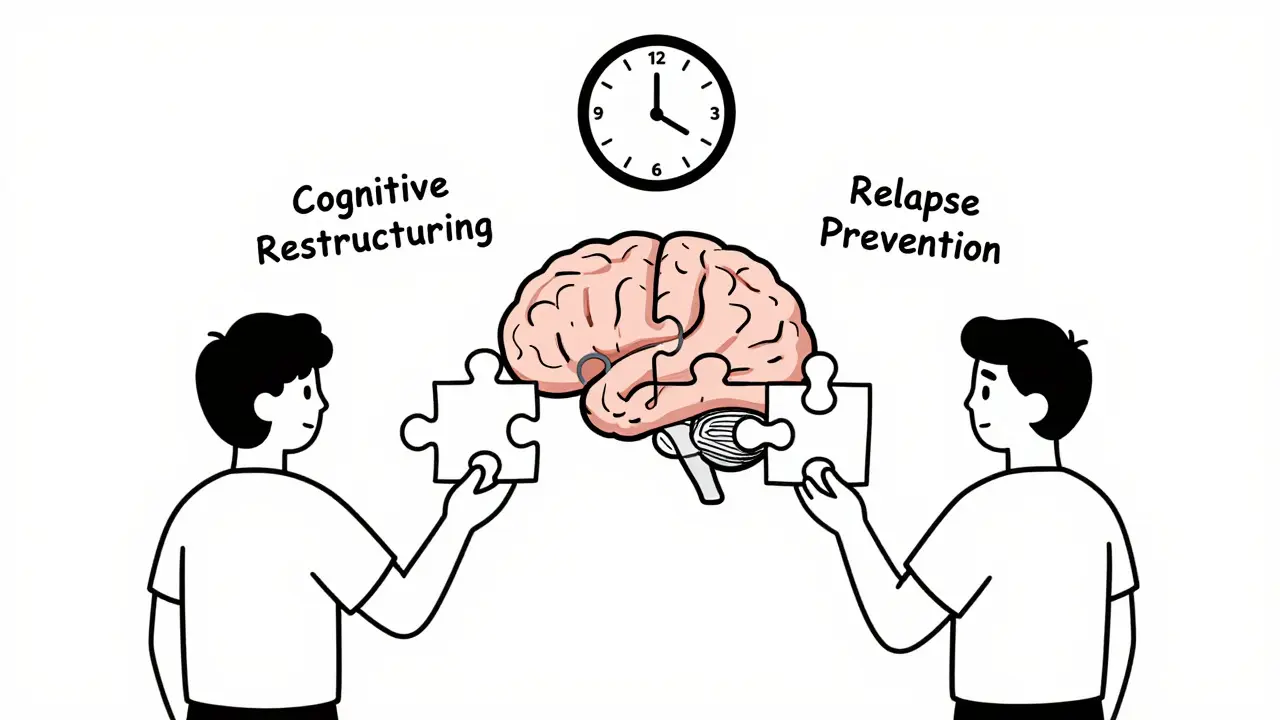
- Cognitive restructuring-This is where you challenge distorted thoughts. For example, if you think, “I can never eat carbs again,” CBT helps you reframe it: “I can enjoy carbs in moderation without losing control.” Studies show this alone reduces emotional eating by 63%.
- Self-monitoring-Writing down what you eat and how you feel isn’t just for dieters. It’s a tool. People who track their meals and moods are 85-90% more likely to stick with their plan. And those who do it consistently lose 5-10% more weight than those who don’t.
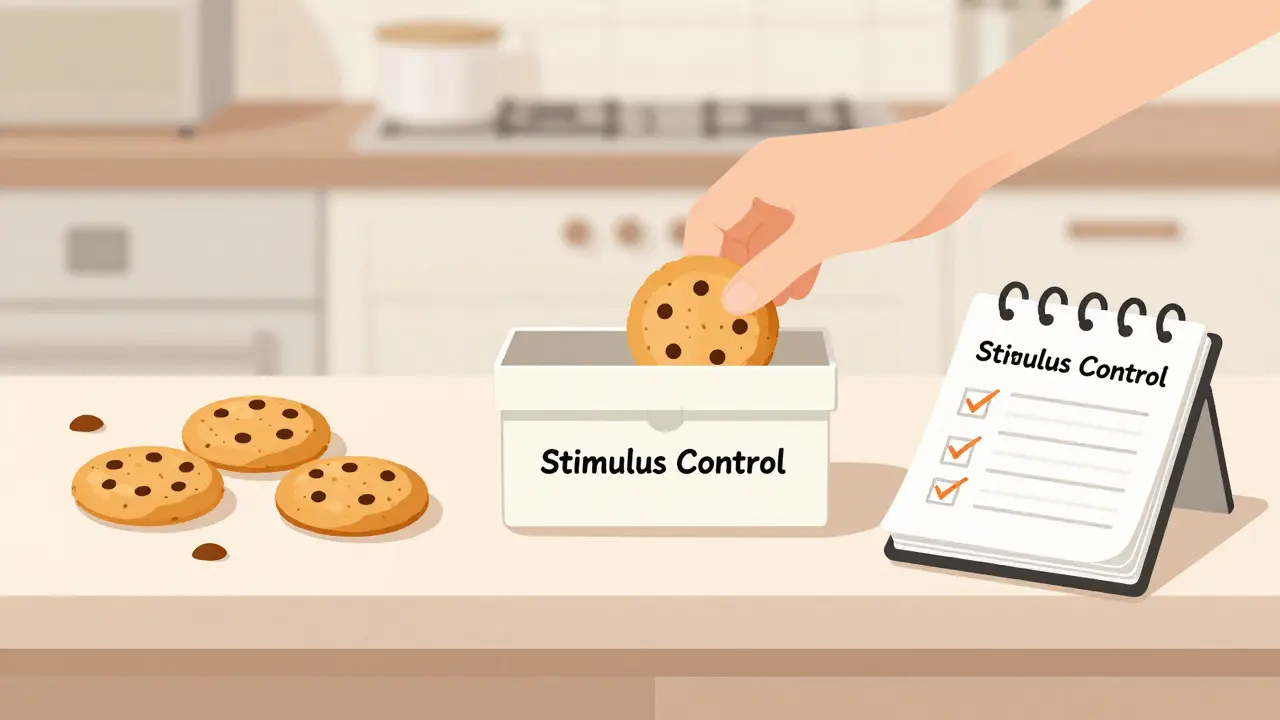
- Stimulus control-Your environment shapes your choices. If snacks are on the counter, you’ll eat them. If your kitchen is stocked with healthy options, you’ll choose them. CBT teaches you to rearrange your space so healthy choices are the easiest ones.
- Goal setting-Vague goals like “lose weight” don’t work. SMART goals do: Specific, Measurable, Achievable, Relevant, Time-bound. Instead of “eat less,” try “have one dessert per week, only after dinner.” Small wins build momentum.
- Problem-solving-What do you do when you’re stressed, tired, or at a party? CBT helps you plan ahead. Role-play tough situations. Practice responses. Build a mental toolkit so you’re not caught off guard.
- Relapse prevention-Most people regain weight within a year. CBT prepares you for that. It’s not about avoiding slips-it’s about recovering from them fast. A slip doesn’t mean failure. It means you need to adjust your strategy.
CBT vs. traditional diets
Standard diet-and-exercise programs often focus on what you do. CBT focuses on why you do it. In one study, people using CBT lost 8.2% of their body weight in six months. Those on standard programs lost 5.1%. The difference? CBT tackles the emotional triggers behind overeating.
Take binge eating disorder (BED). It’s not just about eating too much. It’s about using food to cope with emotions. CBT is the most effective treatment for BED. One study found over half of people with BED were no longer diagnosable five years after CBT. That’s not just weight loss-it’s healing.
And it’s not just about food. People using CBT for weight loss also report 40% fewer symptoms of depression and anxiety. That’s because the same thoughts that lead to overeating-“I’m not good enough,” “I’ll never succeed”-also fuel low mood. Fix the thinking, and both improve.
Delivery matters: In-person, online, or app?
You don’t need a therapist to start, but the format affects results.
Face-to-face CBT has the strongest outcomes. A study from Minnesota State University found in-person therapy delivered 37% better results than phone or self-guided versions. Why? The human connection. A therapist notices when you’re avoiding a topic. They adjust. They push gently. They remind you of your progress when you forget.
But not everyone can access a therapist. That’s where digital options come in. Internet-based CBT (ICBT) platforms like those studied in 2024 show real benefits-reduced BMI, lower stress, improved mood. Apps like Noom and WeightWatchers Beyond the Scale use CBT principles, but their average weight loss is only 3.2%. Compare that to 6.8% with a trained therapist. The tech helps, but it doesn’t replace the human element.
Group CBT is a smart middle ground. A 2022 study found group sessions matched individual therapy outcomes-and cost one-third as much. If you’re shy, start online. If you need accountability, try a group.
The catch: It’s not a quick fix
CBT takes time. Most programs run 12 to 26 weeks. It takes 8 to 12 weeks just to learn how to spot distorted thoughts. Only 45% of people master cognitive restructuring by week six without extra support.
And yes, weight regain is real. Studies show people typically regain 30-35% of lost weight within a year. But CBT reduces that. People who learn relapse prevention are far less likely to spiral after a slip. And when CBT is paired with Motivational Interviewing (MI), dropout rates drop by 22%. MI helps you find your own reasons to change-not because someone told you to, but because you want to.
Even with all this, CBT alone doesn’t guarantee big weight loss. The NIH says it doesn’t “necessarily produce a successful weight loss” as a standalone. But when combined with nutrition advice, physical activity, or even medications like semaglutide, it becomes a powerful tool. The NIH is now funding $14.7 million in research to test CBT + semaglutide-because they know: medicine changes your body. CBT changes your mind.
Who benefits most?
CBT works best for people who:
- Struggle with emotional eating
- Have binge eating disorder
- Feel defeated after small setbacks
- Believe they’ve “failed” if they eat something “bad”
- Have tried diets before and gained the weight back
It’s less effective if you’re looking for a quick fix or if you’re not ready to examine your thoughts. If you’re not willing to write down your meals, challenge your inner critic, or sit with discomfort, CBT won’t stick.
Barriers and realities
There’s a problem: access. In the U.S., there’s only one certified CBT obesity specialist for every 125,000 eligible patients. Rural areas are especially underserved-only 15% of counties have one. Insurance coverage is spotty too. Only 32% of U.S. plans cover more than 12 sessions a year.
That’s why group CBT and digital tools are growing. They’re cheaper, more scalable, and still effective. But don’t mistake convenience for effectiveness. The best outcomes still come from trained professionals who can adapt in real time.
What’s next?
The future of weight loss isn’t just about calories or pills. It’s about psychology. As researchers find new ways to combine CBT with medication, digital tools, and community support, the focus is shifting from “how much you lose” to “how sustainably you live.”
CBT doesn’t promise a perfect body. It promises a better relationship with food, with yourself, and with setbacks. It teaches you that one meal doesn’t define you. That progress isn’t linear. That you’re not broken-you’re learning.
If you’ve tried every diet and still feel stuck, CBT might be the missing piece. Not because it’s magic. But because it’s honest. And sometimes, that’s all you need.
Is CBT for weight loss the same as regular therapy?
No. Regular therapy might explore childhood trauma or relationships. CBT for weight loss is focused and practical. It targets eating behaviors, food-related thoughts, and emotional triggers. The sessions are structured, time-limited, and goal-driven-usually 12 to 26 weeks.
Can CBT help if I’ve had bariatric surgery?
Yes. Many people regain weight after surgery because their relationship with food hasn’t changed. CBT helps address emotional eating, cravings, and distorted thinking about food. Studies show patients who use CBT post-surgery rate their ability to stay on track 2.5 times higher than those who don’t.
Do I need to be diagnosed with binge eating disorder to benefit?
No. While CBT is especially effective for binge eating disorder, it helps anyone who uses food to cope with stress, boredom, or sadness. If you’ve ever eaten when you weren’t hungry, or felt guilty after eating, CBT can help.
How long does it take to see results?
Most people start noticing changes in their eating habits after 4-6 weeks. Weight loss typically becomes visible after 10-12 weeks. But the real benefit-lasting change-shows up after 6 months, when new thought patterns become automatic.
Can I do CBT on my own with an app?
You can start, but don’t expect the same results as with a therapist. Apps like Noom or WeightWatchers Beyond the Scale use CBT principles and can help with awareness and tracking. But they can’t adjust to your emotional state, challenge deep beliefs, or provide accountability like a human therapist can. For lasting change, professional support is still the gold standard.
Is CBT covered by insurance?
Sometimes. In the U.S., only 32% of insurance plans cover more than 12 sessions of CBT for weight loss. In the UK, access varies by region. Check with your provider. If it’s not covered, group programs or university clinics often offer lower-cost options.


Written by Felix Greendale
View all posts by: Felix Greendale