
When you pick up a prescription at the pharmacy, you might see two options: the brand-name drug you remember from your doctor’s office, or a much cheaper generic version. You’ve probably heard the question: Are generics really the same? The answer isn’t just a yes or no-it’s backed by a rigorous scientific process called bioequivalence testing. This isn’t marketing. It’s science. And it’s what lets millions of people save money without sacrificing health.
What Bioequivalence Testing Actually Measures
Bioequivalence testing doesn’t ask whether a generic drug looks the same or tastes the same. It asks: Does your body absorb and use it the same way? The answer comes from tracking how the drug moves through your bloodstream.
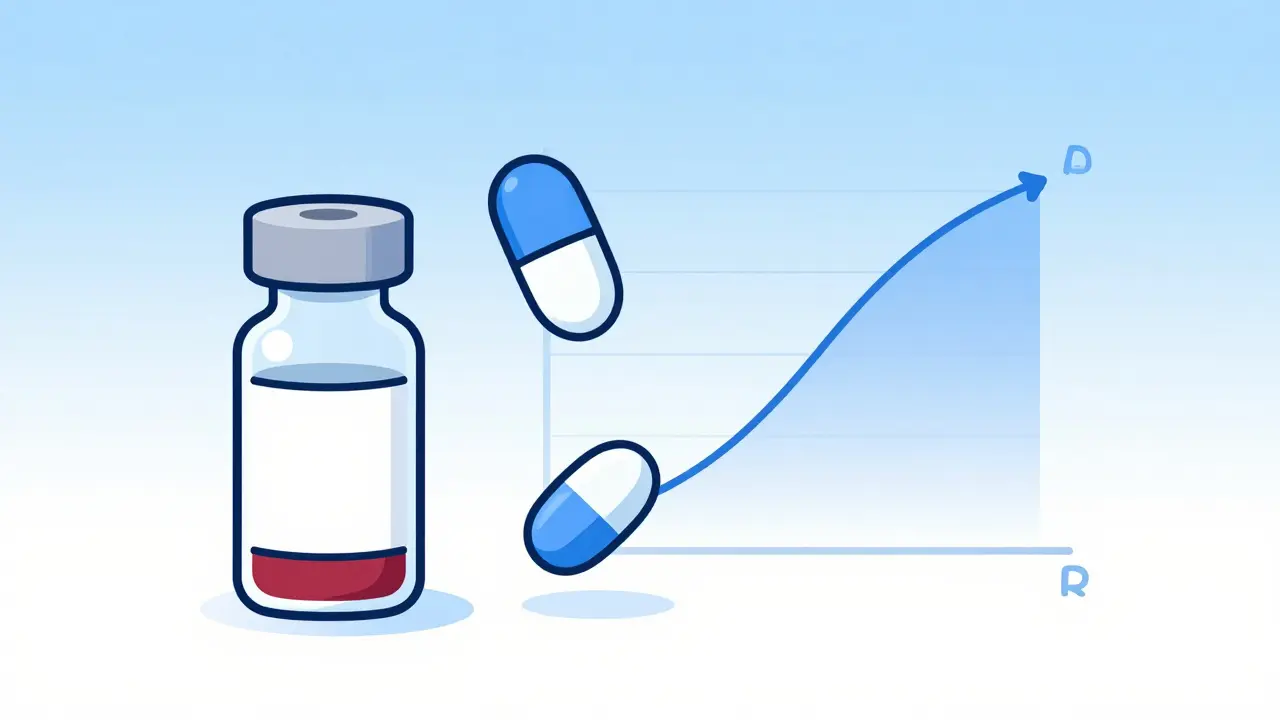
Here’s how it works: Researchers give a group of healthy volunteers (usually 24 to 36 people) both the brand-name drug and the generic version, in a random order, with a waiting period between doses. Blood samples are taken at precise times-every 15 minutes to an hour-over several hours. These samples show how high the drug’s concentration goes in the blood (called Cmax) and how long it stays there (called AUC, or area under the curve).
The FDA requires that the generic’s Cmax and AUC fall within 80% to 125% of the brand-name drug’s values. That’s not a guess. It’s based on decades of data showing that if two drugs perform this closely in the bloodstream, they will have the same effect in the body. A 10% difference in absorption? That’s acceptable. A 30% difference? That’s not. And it won’t get approved.
Why This Matters More Than You Think
Before bioequivalence testing, generic drugs had to repeat the same expensive clinical trials as brand-name drugs. That meant generics were rare and expensive to make. The 1984 Hatch-Waxman Act changed everything. It created the Abbreviated New Drug Application (ANDA) pathway, which let generic manufacturers skip full clinical trials-as long as they proved bioequivalence.
This wasn’t a shortcut. It was a smart one. The brand-name drug had already proven it was safe and effective in thousands of patients. The generic just had to prove it got into the body the same way. That’s why today, 90% of all prescriptions in the U.S. are filled with generics-but they only cost 23% of what brand-name drugs do.
In 2020 alone, generics saved the U.S. healthcare system $313 billion. That’s not just savings for insurers. That’s savings for families paying out-of-pocket. For someone on a fixed income, a $500 monthly brand-name drug might mean choosing between medicine and rent. A $15 generic? That’s life-changing.
What Bioequivalence Testing Doesn’t Cover
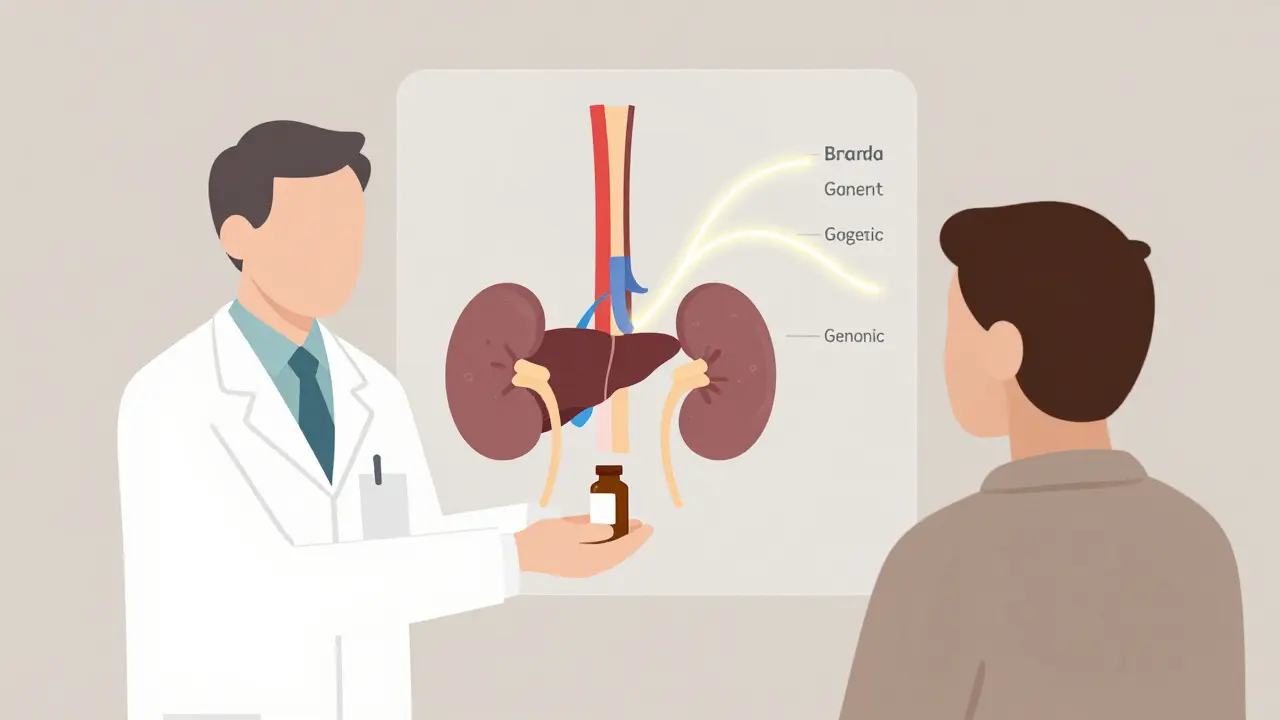
It’s important to know what bioequivalence testing doesn’t do. It doesn’t test how a drug works in people with liver disease, kidney failure, or in children. It doesn’t test long-term side effects. And it doesn’t guarantee identical results for every single person.
That’s why some drugs need extra scrutiny. Take drugs with a narrow therapeutic index-like warfarin, lithium, or levothyroxine. A tiny change in blood levels can mean the difference between no effect and serious harm. For these, the FDA sometimes tightens the bioequivalence range to 90-111%. Some generics for these drugs are even required to undergo additional testing.
Then there are complex delivery systems: inhalers, eye drops, topical creams. You can’t just measure blood levels to know if an asthma inhaler delivers the right dose to the lungs. Or if a cream absorbs through the skin the same way. For these, the FDA requires different kinds of testing-sometimes clinical endpoint studies, sometimes specialized lab methods. The agency has been updating its guidance for these products since 2019.
Real-World Evidence: Do People Notice a Difference?
Despite the science, some people swear their generic doesn’t work as well. Maybe they had a bad experience. Maybe they read something online. A 2022 Consumer Reports survey of 1,200 users found 87% saw no difference between generic and brand-name drugs. Nine percent said the generic worked better. Only 4% said it worked worse.
Reddit threads and pharmacy forums tell similar stories. Most complaints aren’t about effectiveness-they’re about side effects from inactive ingredients. A generic might use a different dye, filler, or coating. That can cause stomach upset, a rash, or a weird taste. But it doesn’t mean the active drug isn’t doing its job.
And here’s something surprising: 32% of patients still believe generics are less potent, even after years of FDA messaging. That myth sticks because people confuse “different-looking pill” with “different medicine.” But a blue pill and a white pill with the same active ingredient, same dose, and same bioequivalence profile? They’re the same drug.
The System Behind the Scenes
Behind every approved generic is a mountain of paperwork and inspection. The FDA requires generic manufacturers to follow strict Good Manufacturing Practices (GMP). Every factory-whether in Indiana or India-is inspected at least once every two years. In 2022, the FDA inspected over 1,200 facilities worldwide.
The ANDA review process takes 10 to 12 months. About 6 to 8 of those months are spent reviewing the bioequivalence study data. The FDA’s Orange Book lists every approved generic and its therapeutic equivalence rating. If a generic is rated “AB,” it means the FDA has confirmed it’s bioequivalent and interchangeable with the brand. If it’s rated “BX,” it means there’s insufficient evidence-so it’s not considered interchangeable.
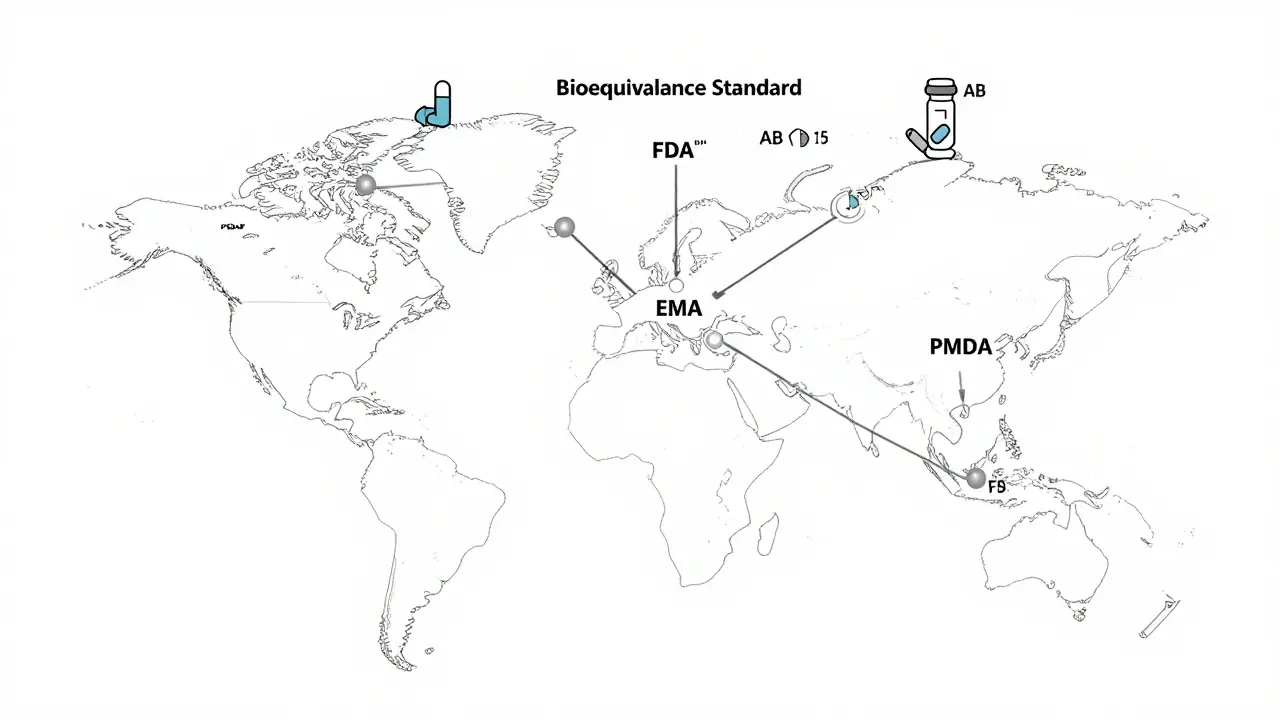
And it’s not just the U.S. The European Medicines Agency, Health Canada, Japan’s PMDA, and others all use similar standards. The International Council for Harmonisation (ICH) ensures these countries agree on what counts as bioequivalent. That’s why a generic made in Germany can be sold in Canada, and one made in the U.S. can be sold in Japan.
What’s Next for Bioequivalence Testing?
The future is getting smarter. Instead of always running human trials, regulators are starting to use computer models. These models simulate how a drug behaves in the body based on its chemical properties, dissolution rates, and known absorption patterns. The FDA’s 2022 draft guidance on Model-Informed Drug Development is a sign this is becoming standard.
For example, a new generic version of a complex extended-release tablet might not need 36 volunteers. A well-validated computer model might be enough-especially if the manufacturer has a long history of making similar products.
But the goal stays the same: ensure that every generic you take is as safe and effective as the brand. Not “close enough.” Not “probably fine.” But scientifically proven.
Bottom Line: You Can Trust the Generic
There’s no magic trick. No hidden catch. Bioequivalence testing is a proven, repeatable, and heavily regulated system. It’s not perfect-but it’s the best we have. And it works.
If you’re switching from a brand-name drug to a generic, talk to your pharmacist. Ask if it’s rated “AB” in the Orange Book. If you notice a change in how you feel-especially if it’s a drug with a narrow therapeutic index-let your doctor know. But don’t assume the generic is weaker just because it costs less.
The science says: if it passed bioequivalence testing, it’s the same drug. The data says: millions of people use it every day with no issue. And the numbers say: without this system, healthcare would be unaffordable for most.
Generic drugs aren’t second-rate. They’re science-approved, cost-saving, life-preserving alternatives. And bioequivalence testing is what makes that possible.
Is bioequivalence testing the same as clinical trials?
No. Clinical trials test whether a new drug is safe and effective in patients with the condition it’s meant to treat. Bioequivalence testing only checks whether a generic drug behaves the same way in the body as the brand-name version. It uses healthy volunteers, not patients, and focuses on absorption, not disease outcomes.
Why do generics look different from brand-name drugs?
By law, generics can’t look identical to brand-name drugs. They must differ in color, shape, or markings to avoid trademark infringement. But the active ingredient, strength, and dosage form must be the same. Differences in appearance have nothing to do with effectiveness.
Are all generic drugs tested the same way?
No. Most oral tablets and capsules use standard pharmacokinetic testing (blood samples). But for inhalers, eye drops, creams, or extended-release tablets, different methods are used-like measuring drug delivery to the lungs or testing dissolution over time. The FDA tailors the test to the drug’s specific behavior in the body.
Can a generic drug be pulled from the market after approval?
Yes. If post-market data shows a generic isn’t performing as expected-like reports of inconsistent absorption or unexpected side effects-the FDA can investigate. If the bioequivalence is no longer valid, the drug can be removed from the Orange Book or recalled. This is rare but possible.
Why do some people say generics don’t work as well?
Most often, it’s due to differences in inactive ingredients-like fillers or coatings-that can cause minor side effects (e.g., stomach upset or allergic reactions). Rarely, a manufacturing issue can cause inconsistent release. But these are exceptions. The vast majority of generics perform identically to brand-name drugs. If you notice a real change, talk to your pharmacist or doctor.
Written by Felix Greendale
View all posts by: Felix Greendale