
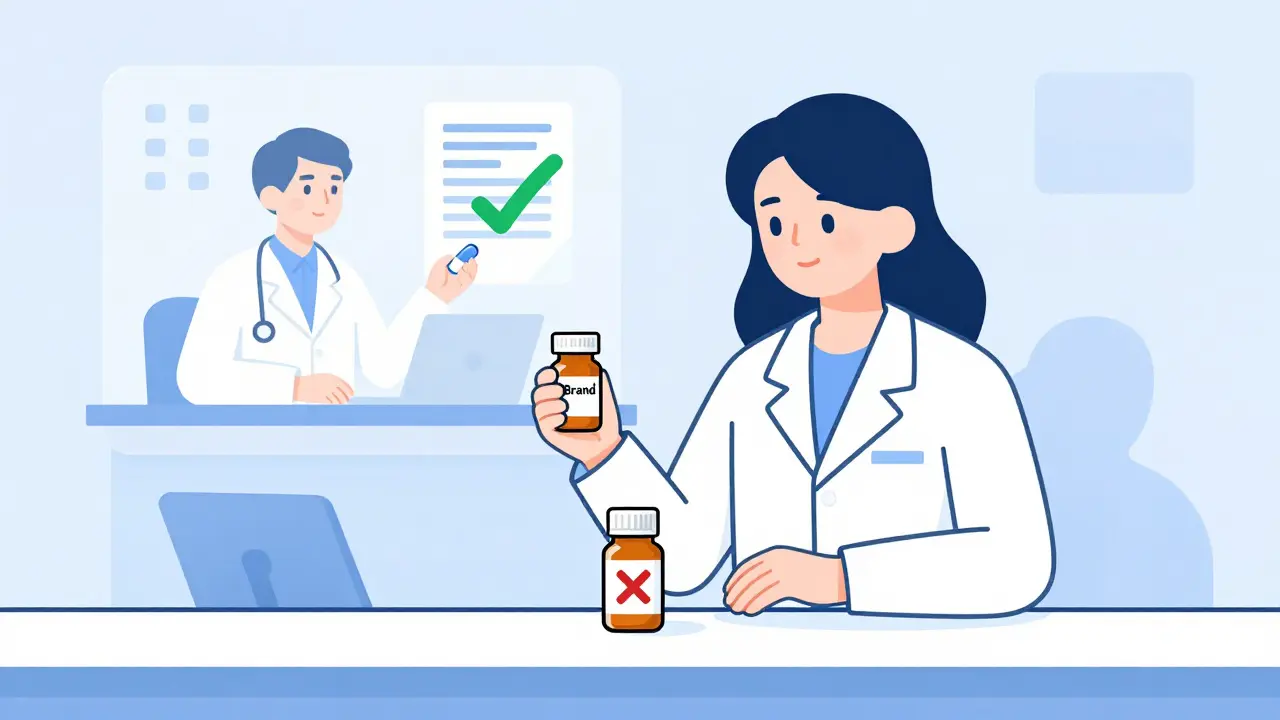
When a pharmacist sees a prescription for a brand-name drug, they don’t just fill it. They look at the cost, the patient’s history, and whether a generic version would work just as well. In most cases, it does. But telling a doctor that? That’s where things get complicated.
Why Generics Are the Default - But Not Always the Choice
More than 97% of prescriptions filled in the U.S. are for generic drugs. That’s not because patients ask for them. It’s because pharmacists recommend them - and they’re backed by science. The FDA requires generics to have the same active ingredients, strength, and dosage form as the brand-name version. Bioequivalence testing shows that 98.7% of approved generics deliver drug levels within 95%-105% of the original. That’s tighter than most brand-name drugs ever are. But here’s the catch: not every prescriber knows that. A 2023 survey found that 37.6% of doctors still worry generics aren’t as effective. That’s especially true for complex drugs like inhalers and topical creams, where delivery matters. One doctor might assume a generic inhaler won’t deliver the same dose. Another might think a generic patch won’t absorb properly. These aren’t myths - they’re misunderstandings.When Pharmacists Must Speak Up
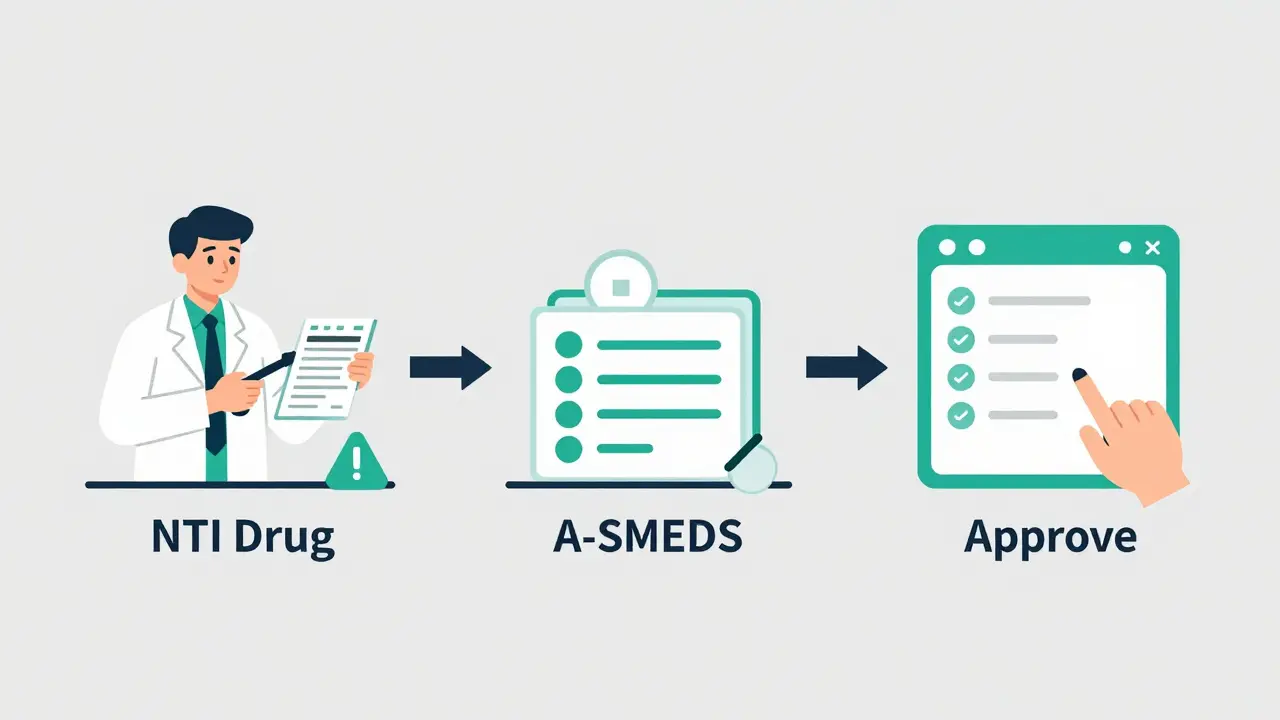
Pharmacists don’t just swap drugs. They decide when to speak up. There are three big red flags that demand a conversation with the prescriber. First, narrow therapeutic index (NTI) drugs. These are medications where even a tiny change in dose can cause harm. Warfarin, levothyroxine, and phenytoin fall into this category. The FDA has specific guidelines for these - only 12 out of 1,456 product-specific guidances address them. Pharmacists know this. They check the Orange Book. If the generic has an 'A' rating (meaning therapeutic equivalence), they still pause. Why? Because some patients react differently. A 2021 study showed that 1 in 12 patients have allergies to inactive ingredients - things like dyes, fillers, or preservatives that can vary between brand and generic. That’s not rare. That’s routine. Second, when the prescription says "dispense as written" (DAW). About 15.3% of all prescriptions have this mark. Often, it’s because the prescriber has a specific concern. Maybe the patient had a bad reaction before. Maybe they’re on a complex regimen. Pharmacists don’t ignore it. They call. They ask: "Why?" And they bring data. A 2023 study found that when pharmacists cited specific bioequivalence data - not just "it’s the same" - prescriber acceptance jumped by over 34 percentage points. Third, when the patient has known allergies or sensitivities. One patient might be allergic to lactose. Another to FD&C Yellow No. 5. These aren’t in the active ingredient. They’re in the capsule, the coating, the tablet binder. The FDA allows different inactive ingredients in generics. And the American Society of Health-System Pharmacists says: if you don’t check, you’re risking harm. That’s why pharmacists now cross-reference prescriptions with A-SMEDS data - a database of excipient allergens.The Right Way to Talk to a Prescriber
A quick call. A secure message. A note in the EHR. It’s not about arguing. It’s about collaborating. The American Society of Health-System Pharmacists laid out a clear four-step framework:- Reach out within 24 hours of receiving the prescription.
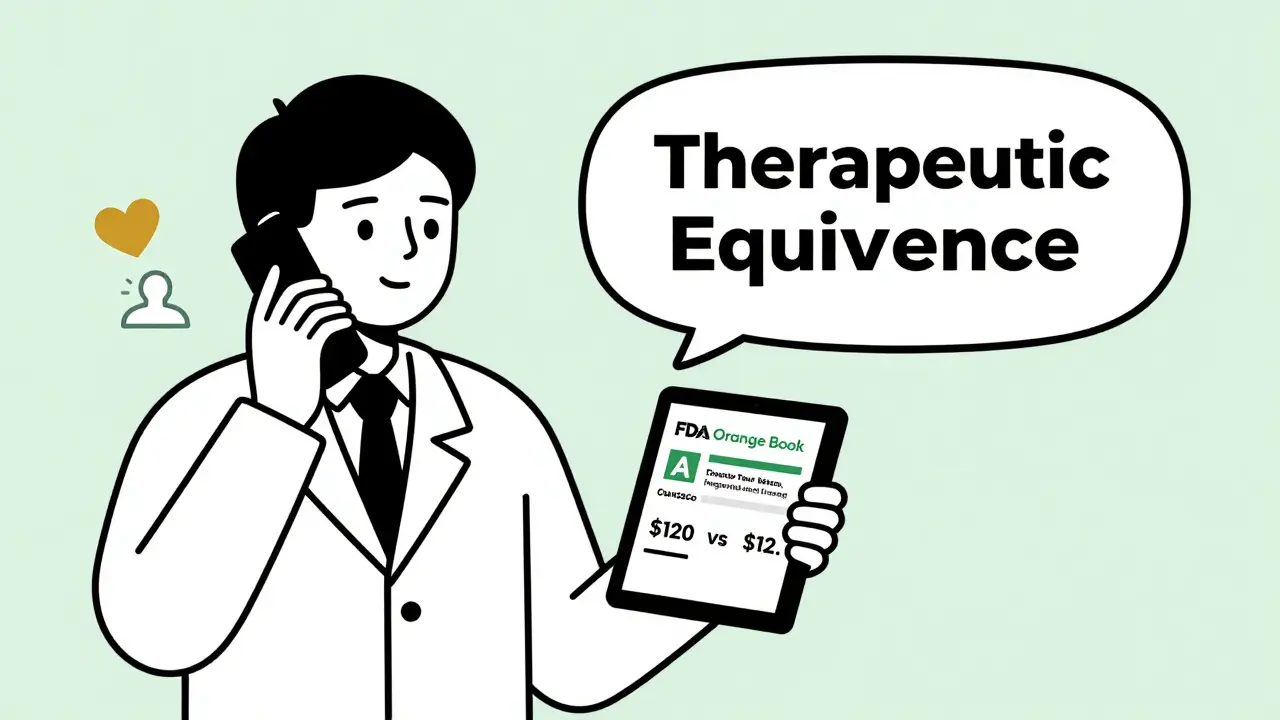
- Reference the FDA’s Orange Book rating - "This generic has an A rating for therapeutic equivalence."
- Show the cost difference - "The brand is $120. The generic is $12."
- Document the conversation - date, time, method, outcome.
Technology Is Changing the Game
In 2023, 87% of U.S. prescribers use Surescripts’ Generic Drug Substitution module. That’s not a fancy app. It’s built into the e-prescribing system. When a pharmacist flags a substitution, the system auto-populates the Orange Book rating, cost data, and even links to the FDA’s product-specific guidance. The prescriber sees it in their inbox. They click "approve" or "deny." The whole thing takes 2.7 minutes - down from over 8 minutes. Even better? Documentation jumped from 63.5% to 94.8%. That means every decision is traceable. That’s not just good practice. It’s insurance. AI tools are now stepping in too. PharmAI’s Generic Substitution Assistant, used by nearly 30% of chain pharmacies, pulls real-time data from the Orange Book, patient history, and formulary rules. It suggests the best generic and drafts a message. Pharmacists tweak it. Send it. Acceptance rates hit 94.2%. That’s not magic. That’s data-driven communication.Barriers Still Exist
Let’s be real. Pharmacists are stretched thin. The 2023 National Pharmacist Workload Survey found they have just 2.3 minutes per prescription to verify, counsel, and document. That’s not enough time to call every prescriber. And some doctors still don’t trust generics. A 2023 Medscape report showed:- 58.3% worry about therapeutic equivalence
- 47.6% fear altered patient response
- 62.1% say they don’t have time to evaluate requests
What’s Changing in 2025 and Beyond
The Inflation Reduction Act of 2022 is reshaping how pharmacists work. Starting January 2025, Medicare Part D will expand medication therapy management (MTM) services. That means pharmacists will be formally paid to review prescriptions, recommend generics, and follow up with prescribers. An estimated 21.3 million Medicare beneficiaries will be affected. Meanwhile, the FDA is updating the Orange Book to include real-world evidence - not just lab data. Think: how many patients actually had stable INRs on a generic warfarin? How many had skin irritation from a generic patch? That data will be live. Available. Used. And the CDC’s proposed Generic Medication Safety Network - launching in late 2024 - will alert pharmacists in near real-time if a generic product reports unexpected side effects. That’s not science fiction. It’s the next step.Documentation Isn’t Optional
If you don’t document it, it didn’t happen. That’s the rule in every state. The Centers for Medicare & Medicaid Services audit pharmacies. In 2023, 98.7% of pharmacies using EHR-integrated documentation passed. Only 76.4% of those using paper logs did. The AMA and APhA agree on what to record:- Date and time of communication
- Method used (phone, secure message, portal)
- Prescriber name and credentials
- Specific recommendation (which generic, why)
- Outcome (approved, denied, pending)
It’s Not About Saving Money - It’s About Saving Lives
A 2018 study tracked 12.7 million patients. Those switched to generics had a 12.4% improvement in medication adherence. That’s not small. That’s huge. And it led to a 28.6% drop in non-adherence - and a 15.2% reduction in hospital admissions for chronic conditions. Generics aren’t cheaper because they’re worse. They’re cheaper because they don’t need to pay for ads, branding, or patent lawsuits. The science? It’s identical. The results? Better. Pharmacists aren’t just filling prescriptions. They’re preventing hospital stays. Reducing costs. Saving lives. But they can’t do it alone. They need prescribers who listen. And they need systems that make it easy to speak up.Can pharmacists substitute generics without prescriber approval?
In 49 states, pharmacists can substitute a generic if it’s rated therapeutically equivalent (an "A" rating in the FDA’s Orange Book) and the prescriber hasn’t marked "dispense as written." But 17 states require patient consent, and five states limit substitution to specific generics listed in their formulary. Always check your state’s rules.
Why do some doctors refuse generic substitution?
Some doctors worry about bioequivalence, especially for complex drugs like inhalers or topical creams. Others have had a patient report a change in response. But research shows these concerns are often based on perception, not data. A 2023 study found that when pharmacists provided specific bioequivalence data - like AUC and Cmax ranges - prescriber acceptance increased by over 34 percentage points.
Are generics really as safe as brand-name drugs?
Yes. The FDA requires generics to meet the same strict standards for identity, strength, quality, purity, and performance as brand-name drugs. Bioequivalence testing must show that the generic delivers the drug within 80%-125% of the brand’s levels - and in practice, 98.7% of generics fall within 95%-105%. The FDA monitors adverse events for both brand and generic versions equally.
What role does the FDA’s Orange Book play?
The Orange Book lists all approved drug products with therapeutic equivalence ratings. It’s the gold standard. An "A" rating means the generic is therapeutically equivalent to the brand. A "B" rating means it’s not. Pharmacists use it daily to decide whether substitution is appropriate. In 2023, 92.7% of listed generics had an "A" rating.
How do pharmacists handle patients with allergies to inactive ingredients?
Pharmacists check the inactive ingredients in both the brand and generic versions using databases like A-SMEDS. If a patient has a known allergy - say, to lactose or a specific dye - the pharmacist will either select a different generic with compatible excipients or contact the prescriber to discuss alternatives. About 8.7% of substitution issues stem from these allergens, making this step critical.


Written by Felix Greendale
View all posts by: Felix Greendale