
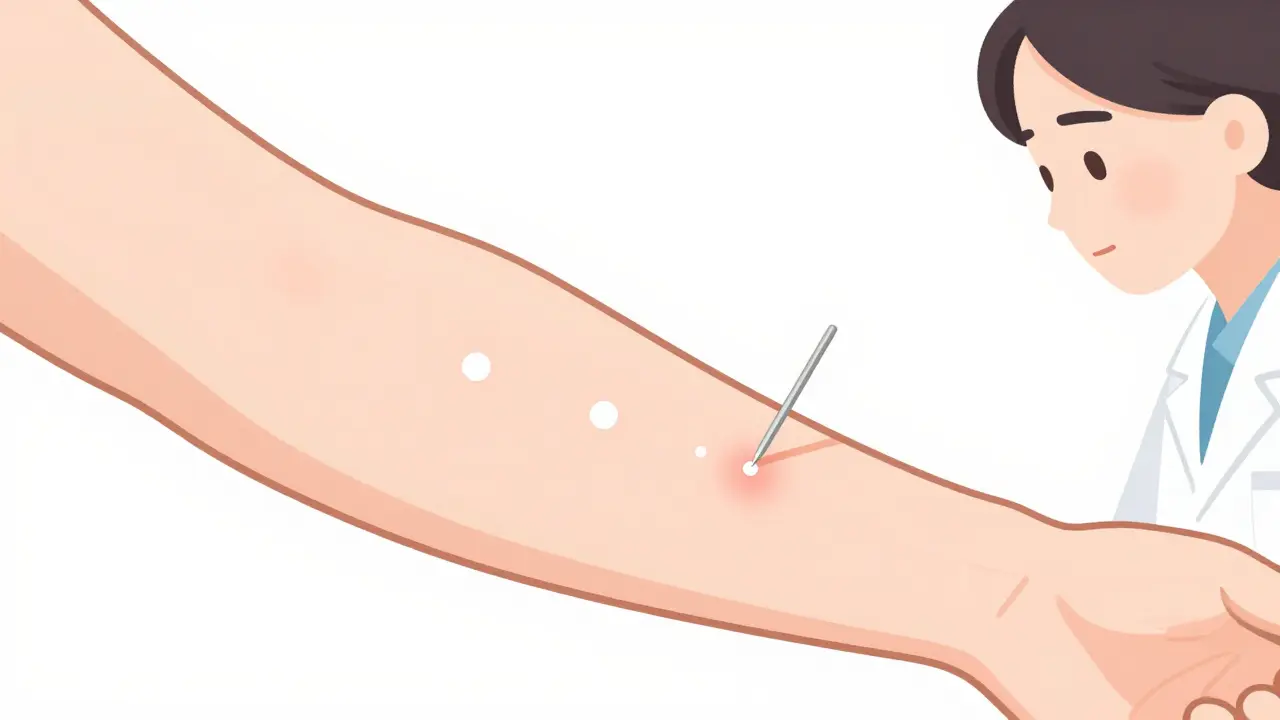
Have you ever been told you’re allergic to penicillin, only to find out later that you’ve taken it before without any problem? You’re not alone. Around 10% of people in the U.S. say they’re allergic to penicillin, but 90% of them turn out not to be when tested properly. That’s not just a mislabel-it can affect your health, your treatment options, and even your recovery time. Drug allergy skin testing is one of the most reliable ways to find out if you truly have a drug allergy-or if you’ve been carrying around a label that doesn’t fit.
What Is Drug Allergy Skin Testing?
Drug allergy skin testing is a safe, simple procedure used to see if your body reacts to specific medications. It doesn’t involve swallowing pills or getting an IV. Instead, a small amount of the drug is placed on your skin, then introduced just below the surface to see if your immune system responds. If you’re allergic, your skin will react with redness, swelling, or itching at the test site.
This isn’t guesswork. It’s based on decades of research and standardized protocols from groups like the British Society for Allergy and Clinical Immunology (BSACI) and the European Academy of Allergy and Clinical Immunology. The test is especially useful for antibiotics like penicillin, but it’s also used for other drugs like NSAIDs, sulfa medications, and even some painkillers.
How the Test Works: Three Main Types
There are three main types of skin tests used for drug allergies, each suited to different kinds of reactions.
- Skin prick test (SPT): This is the gentlest option. A tiny drop of the drug solution is placed on your skin-usually your forearm or back-and a small, sterile needle lightly pricks the surface. It’s like a quick mosquito bite. No blood is drawn. Results show up in 15 to 20 minutes.
- Intradermal test (IDT): If the skin prick test is negative but the doctor still suspects an allergy, they may do an intradermal test. A small amount of the drug is injected just under the skin with a fine needle, creating a tiny bump (a bleb). The size of the bump is measured after 15-20 minutes. A positive result means the bump grew by 3 mm or more. This test is more sensitive but also more likely to give a false positive.
- Patch test: This one’s for delayed reactions, like rashes that appear hours or days after taking a drug. A patch soaked with the drug is taped to your skin for 48 hours. You come back to have it removed and checked for redness or blistering. This is not used for immediate reactions like hives or anaphylaxis.
Both the skin prick and intradermal tests include controls: a positive control (histamine) to make sure your skin can react, and a negative control (saline) to make sure nothing else is causing a reaction. If the histamine doesn’t cause a bump, the test may be invalid.
What You Need to Do Before the Test
Preparation matters. If you’re taking antihistamines-whether it’s Claritin, Zyrtec, Benadryl, or even allergy eye drops-you’ll need to stop them at least 5 to 7 days before testing. These meds can block your skin’s reaction, leading to a false negative. That’s one of the most common reasons people have to reschedule their test.
Also, avoid steroids, cold medicines, and sleep aids with antihistamines. If you’re unsure, ask your doctor. Bring a list of all your medications with you. Don’t assume your pharmacist knows what you’re taking for allergies-it’s easy to miss.
Wear a short-sleeve shirt. The test is usually done on your arms or back. No lotions or creams on the test area. Shower normally, but don’t scrub the area.
What Happens During the Test
The whole process takes about 45 to 60 minutes. First, your skin is cleaned and marked with a permanent marker so each test site is clearly labeled. Then, the skin prick test is done first. If needed, the intradermal test follows, usually after a 15-minute wait.
You’ll feel a slight sting with the intradermal test-some people describe it as a quick pinch or a burning sensation that lasts a minute or two. It’s not unbearable, but it’s noticeable. The skin prick test? Most people say it feels like nothing at all.
After each test, you’ll wait 15 to 20 minutes while the medical team watches for any changes. If you’re having a reaction, it will show up as a red, raised bump-like a mosquito bite, but more defined. The team will measure it with a ruler. They’ll also take photos of the sites for your records. This isn’t just for safety-it helps future doctors understand your history.
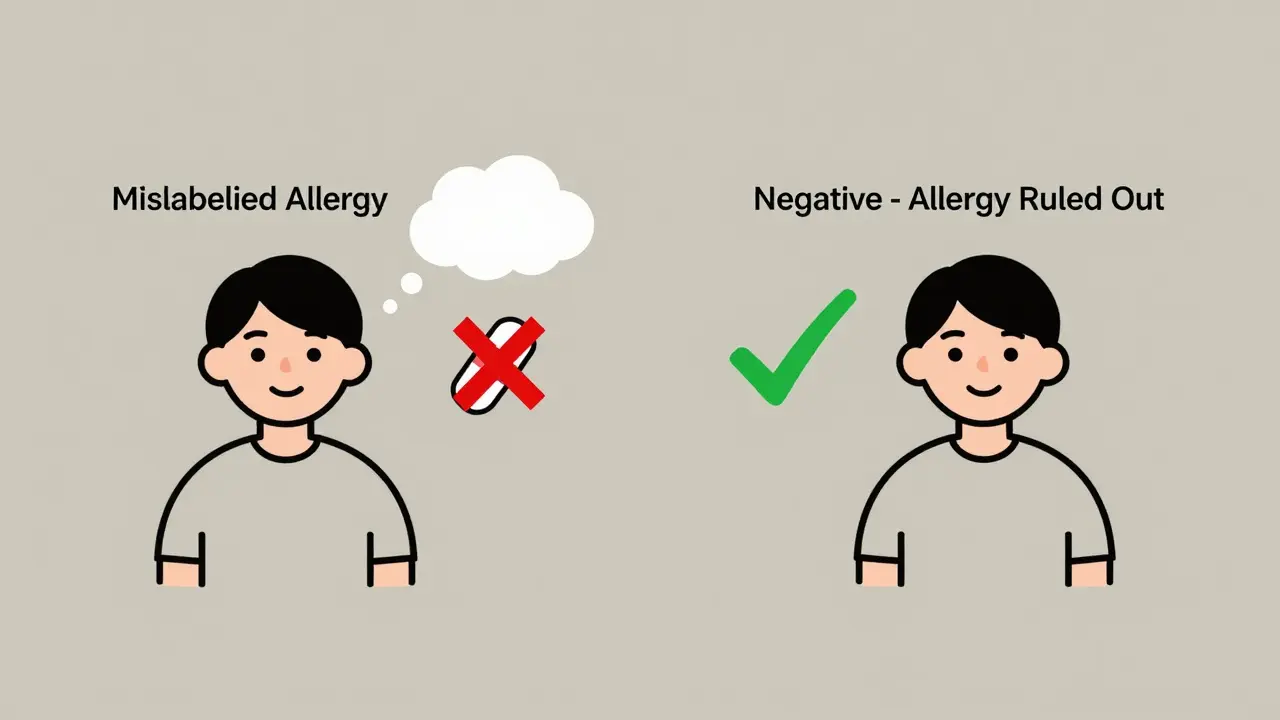
What the Results Mean
A positive result means you likely have an allergy to that drug. But a negative result doesn’t always mean you’re completely safe.
For penicillin and related antibiotics, a negative skin test combined with a negative intradermal test has a 95% to 98% negative predictive value. That means if both tests are negative, you’re almost certainly not allergic. Many people who test negative go on to safely take the drug under supervision-a process called a drug challenge.
But for other drugs-like cephalosporins, sulfa drugs, or NSAIDs-the tests are less reliable. Sensitivity can drop as low as 30%. That’s why doctors sometimes recommend a drug challenge even after a negative skin test. It’s riskier, but sometimes necessary.
One patient in a Cleveland Clinic case study had a long history of penicillin allergy. She avoided all penicillin-based antibiotics for years. After negative skin tests and a supervised amoxicillin challenge, she was able to take the drug safely. Her infection cleared faster, and she avoided broader-spectrum antibiotics that carry higher risks of side effects.
Who Shouldn’t Get Tested?
Not everyone is a candidate. Skin testing is not done during an active allergic reaction. If you’re having hives, swelling, or trouble breathing right now, you need emergency care-not a skin test.
People with severe, uncontrolled asthma are also usually not tested. The risk of triggering a reaction is too high. If you have a history of anaphylaxis, your doctor may still test you-but only in a controlled setting with emergency equipment nearby.
And no, you can’t do this at home. These tests require trained staff who know how to handle anaphylaxis. That’s why they’re only done in allergy clinics, hospitals, or specialized outpatient centers.
Why This Matters for Your Health
Labeling yourself as allergic to penicillin without proof can lead to worse health outcomes. When doctors avoid penicillin because of a suspected allergy, they often turn to broader-spectrum antibiotics like vancomycin or fluoroquinolones. These drugs are more expensive, more likely to cause side effects, and more likely to lead to infections like C. difficile-a serious gut infection that can be deadly.
Hospitals that have formal allergy testing programs have seen a 30% drop in broad-spectrum antibiotic use. One study found those hospitals also had 22% fewer C. difficile infections. That’s not just about saving money-it’s about saving lives.
And here’s the kicker: if you’re labeled allergic to penicillin, you’re more likely to be prescribed antibiotics that contribute to antibiotic resistance. That’s a global health threat. Getting tested isn’t just about you-it helps protect the effectiveness of antibiotics for everyone.
What Comes After the Test
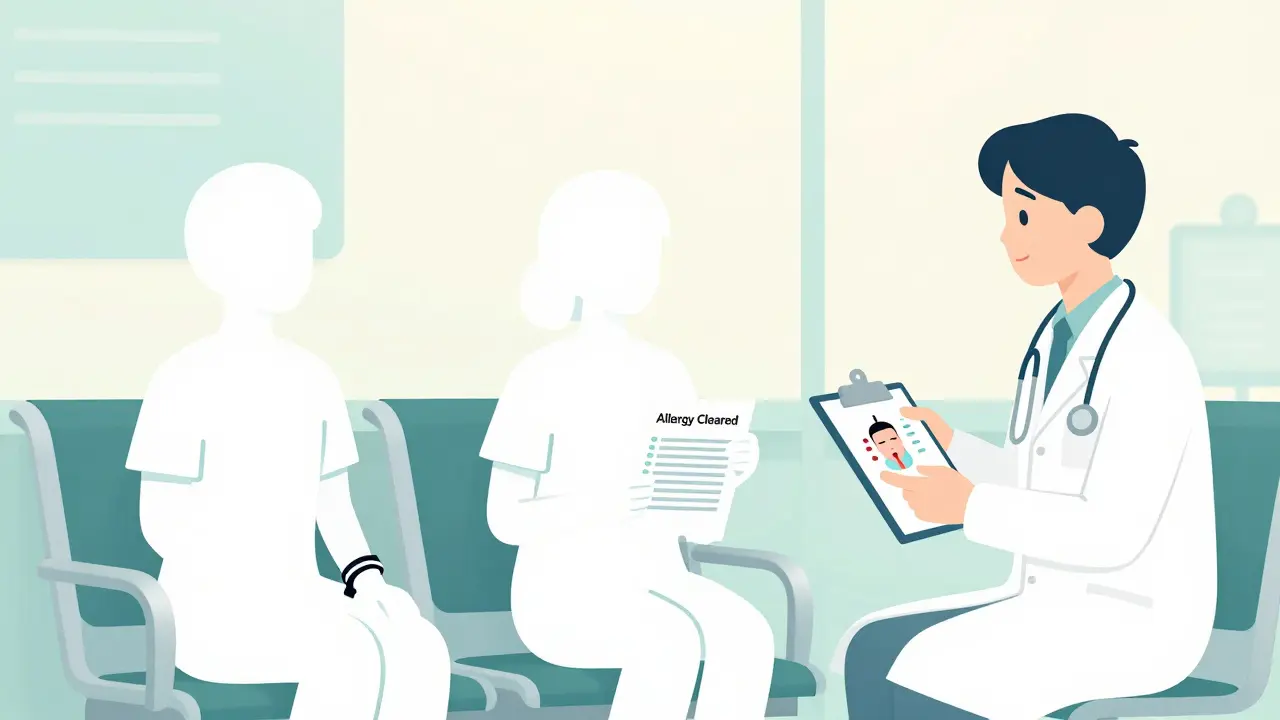
If your test is negative, your doctor may recommend a drug challenge: taking a small, increasing dose of the drug under observation. This confirms you can tolerate it. Many patients leave the clinic with a new note in their medical record: “Penicillin allergy ruled out.”
If the test is positive, you’ll get a medical alert bracelet or a note in your electronic health record. You’ll also get a list of safe alternatives. For example, if you’re allergic to penicillin, you might be able to take a different class of antibiotics like macrolides or tetracyclines.
And if you’re unsure? Ask. Many people never get tested because they don’t know it’s an option. Talk to your doctor, especially if you’ve never had a serious reaction. You might be surprised at what you find out.
Common Myths About Skin Testing
- Myth: Skin testing causes a full-body allergic reaction.
- Fact: The drug stays in the top layer of skin. Systemic reactions are extremely rare. Most clinics have epinephrine on hand just in case-but it’s rarely needed.
- Myth: If I had a rash as a kid, I’m definitely allergic.
- Fact: Many rashes from antibiotics are not allergic. They’re side effects. Only a small percentage are true IgE-mediated allergies.
- Myth: I don’t need to get tested because I’ve never taken the drug.
- Fact: Even if you’ve never taken penicillin, you might still be allergic due to cross-reactivity with environmental bacteria. Testing clears the air.
What’s New in 2026
Recent advances are making testing even better. In 2022, the European Medicines Agency approved standardized penicillin reagent kits, so every clinic uses the same, reliable mix. Before, reagents varied between hospitals, making results inconsistent.
Now, researchers are working on test reagents for other drugs like ciprofloxacin and vancomycin. Phase 2 trials are underway. There’s also growing use of component-resolved diagnostics-testing for specific parts of the drug molecule-to reduce false positives.
And more hospitals are launching “allergy delabeling” programs. These are structured efforts to retest patients with old allergy labels. In the UK, pilot programs have already cleared over 60% of patients who thought they were allergic to penicillin.
What does this mean for you? If you’ve been told you’re allergic to a drug, it’s worth asking: “Has this been confirmed with a skin test?” You might be surprised at the answer.


Written by Felix Greendale
View all posts by: Felix Greendale