

Dry Eye Treatment Strategy & Cost Estimator
Build Your Plan
Your Estimated Strategy
Recommended Routine
Staring at a screen all day only to feel like your eyes are filled with sand is more than just annoying-it’s a sign that something is wrong. You aren’t alone. Millions of adults suffer from Dry Eye Disease (DED), a condition where your eyes don't produce enough tears or the tears evaporate too quickly. It affects roughly 16.4 million people in the US alone. The good news? You can fix it. But you need the right tools. Whether it’s over-the-counter drops, prescription meds, or simply changing the air in your room, managing this condition requires a mix of immediate relief and long-term strategy.
This guide cuts through the noise. We’ll look at what actually works, how much it costs, and why combining lubricants with environmental changes like humidifiers is often the secret weapon doctors don’t have time to explain fully.
Understanding Your Dry Eyes: It’s Not Just About Water
Before you buy another bottle of drops, you need to know what kind of dry eye you have. Most people assume their eyes are just "dry" and need water. That’s rarely the whole story. According to the Tear Film & Ocular Surface Society, about 86% of dry eye cases are evaporative. This means your tears are fine, but they’re vanishing before they can do their job because the oil layer on top is missing or unstable.
If you have evaporative dry eye, pouring water-based artificial tears into your eyes is like trying to put out a grease fire with a garden hose. It might cool things down for a minute, but the problem remains. You need lipid-based treatments that seal in moisture. If you have aqueous-deficient dry eye, your tear glands literally aren’t making enough fluid. In that case, anti-inflammatory medications that stimulate production are key. Knowing which one you have saves you money and frustration.
The First Line of Defense: Artificial Tears and Lubricants
For mild symptoms, over-the-counter (OTC) artificial tears are your best friend. They come in two main types: low-viscosity and high-viscosity.
- Low-viscosity drops: Think of brands like Refresh Tears. These are watery, clear, and provide quick relief for 1-2 hours. Use these if you work at a computer and need to blink away fatigue without blurring your vision.
- High-viscosity gels: Products like Refresh Celluvisc are thicker. They last longer-up to 4-6 hours-but they will blur your sight temporarily. Save these for bedtime or when you’re off screens.
Look for ingredients like sodium hyaluronate or carboxymethylcellulose. Avoid drops with preservatives if you’re using them more than four times a day; preservatives can irritate the surface over time. If you wear contacts, remove them before applying most drops, then wait 15 minutes before putting them back in.
Prescription Powerhouses: When Drops Aren’t Enough
If OTC tears don’t cut it, it’s time to talk to an ophthalmologist. Prescription medications target the root cause: inflammation. Here is how the current heavy hitters stack up in 2026.
| Medication | Active Ingredient | How It Works | Onset of Relief | Avg. Cost (30-day) |
|---|---|---|---|---|
| Restasis (Generic available) | Cyclosporine 0.05% | Reduces inflammation in lacrimal gland to boost tear production | 3-6 months | $150 - $250 (Generic) |
| Xiidra | Lifitegrast 5% | Blocks T-cell inflammation pathways | 2 weeks | $450 - $550 |
| Miebo | Perfluorohexyloctane 3.5% | Forms a protective lipid barrier to stop evaporation | Immediate | $650 |
| Tyrvaya | Varenicline Nasal Spray | Stimulates nerves to increase tear and mucus production | Few days | $200 |
Restasis has been around since 1998. It’s effective, but the burning sensation upon application makes many people quit. Generic cyclosporine is now widely available and significantly cheaper, making it a solid first choice for long-term management if you can tolerate the initial sting.
Xiidra works faster than Restasis, often showing results within two weeks. However, it can still cause stinging, and the cost is steep without insurance.
Miebo, approved in 2023, is a game-changer for evaporative dry eye. It uses a semifluorinated alkane to create a shield over the eye. Patients report immediate relief, and clinical trials showed excellent tolerability. The downside? Price. At $650 a month, it’s out of reach for many unless covered by comprehensive insurance.
Tyrvaya is unique because it’s a nasal spray, not an eye drop. By stimulating the trigeminal nerve in the nose, it triggers tear production. It’s great for people who struggle with instilling drops accurately.

The Underrated Hero: Using Humidifiers Correctly
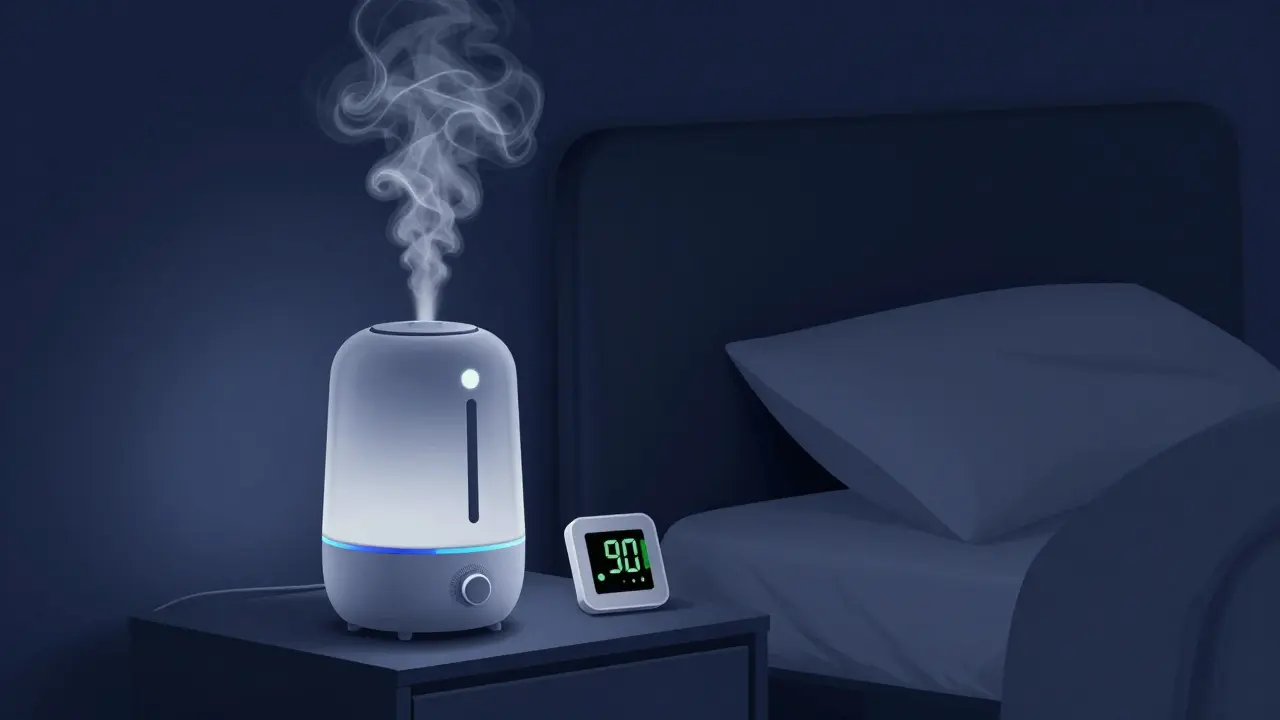
We often forget that our environment plays a massive role in eye health. If the air in your home or office is dry, your tears evaporate faster. This is where a cool-mist humidifier becomes essential.
Studies show that maintaining indoor relative humidity between 40% and 60% can significantly reduce nighttime dry eye symptoms. Don’t just plug it in and walk away. Follow these rules:
- Placement matters: Keep the humidifier near your bed or desk, but not directly blowing air at your face. Aim for indirect circulation.
- Clean it weekly: Humidifiers are breeding grounds for mold and bacteria if neglected. Use distilled water to minimize mineral buildup and clean the tank with white vinegar every week.
- Monitor levels: Buy a cheap hygrometer (humidity monitor). If the air gets too moist (above 60%), you risk dust mites and mold growth, which can worsen allergies and eye irritation.
Many users report that combining a nightly humidifier routine with morning artificial tears creates a stable baseline of comfort throughout the day.
Combination Therapy: Why One Thing Isn’t Enough
Here’s the hard truth: dry eye is chronic. For most people, no single cure exists. The most successful patients use a multimodal approach. This might look like:
- Morning: Tyrvaya nasal spray to kickstart tear production.
- During Work: Preservative-free artificial tears every 2-3 hours + a desktop humidifier.
- Evening: Miebo drops to seal in moisture while you sleep.
- Long-term: Restasis or Xiidra twice daily to keep inflammation down.
This layered strategy addresses both the lack of tears and the rapid evaporation. It also mitigates the side effects of any single drug. For example, if Restasis burns, using Miebo for immediate comfort can make sticking to the long-term regimen easier.
Practical Tips for Success
Getting started with new eye medications can be tricky. Here is how to avoid common pitfalls:
- Refrigerate your drops: Cold drops numb the eye slightly, reducing the burning sensation from cyclosporine or lifitegrast. Many users find this simple trick makes medication adherence possible.
- Wait between drops: If you use multiple types of drops, wait at least 5-10 minutes between applications. Otherwise, the second drop washes out the first.
- Don’t touch the tip: Always keep the dropper tip above your eye. Touching it to your eyelid or lashes introduces bacteria, leading to infections.
- Track your symptoms: Use a journal or app to note when your eyes feel worst. This helps your doctor adjust your treatment plan based on real-world data, not just guesswork.
Cost Considerations and Insurance
Let’s talk money. Dry eye treatment can get expensive fast. While generic cyclosporine has brought prices down to $150-$250 per month, newer agents like Miebo remain pricey. Before starting a new medication, check with your insurance provider. Many plans require "step therapy," meaning you must try and fail on cheaper options like Restasis before they cover Xiidra or Miebo.
If cost is a barrier, ask your doctor about patient assistance programs. Manufacturers often offer coupons or discounts for uninsured patients. Also, consider that spending less on ineffective OTC drops over years adds up. Investing in a proper diagnosis and targeted prescription may save money in the long run by preventing corneal damage and vision loss.
How long does it take for dry eye medications to work?
It depends on the medication. Artificial tears provide immediate but temporary relief. Miebo offers instant symptom reduction by sealing in moisture. However, anti-inflammatory prescriptions like Restasis (cyclosporine) can take 3 to 6 months of consistent use to show full benefits. Xiidra typically shows improvement within 2 weeks.
Can I use artificial tears with contact lenses?
Yes, but you must choose drops labeled as safe for contact lens wearers. Generally, you should remove your lenses before applying most prescription medications and wait 10-15 minutes before reinserting them to ensure proper absorption and avoid contamination.
Is a humidifier really necessary for dry eye relief?
While not strictly "necessary" for everyone, a humidifier is highly recommended, especially if you live in a dry climate or use heating/AC systems. Maintaining indoor humidity between 40-60% reduces tear evaporation rates, complementing the effects of eye drops and medications.
Why do my prescription eye drops burn?
Burning is a common side effect of anti-inflammatory drops like Restasis and Xiidra due to the active ingredients and pH levels. Refrigerating the bottle before use can numb the eye slightly and reduce this sensation. If burning persists or worsens, consult your ophthalmologist, as it may indicate sensitivity or incorrect usage.
What is the difference between evaporative and aqueous-deficient dry eye?
Evaporative dry eye occurs when tears evaporate too quickly, usually due to poor quality oil layers from meibomian gland dysfunction. Aqueous-deficient dry eye happens when the lacrimal glands don't produce enough water-based tears. Evaporative is more common (86% of cases) and responds better to lipid-based treatments like Miebo, while aqueous-deficient often requires inflammatory inhibitors like cyclosporine.
Written by Felix Greendale
View all posts by: Felix Greendale