
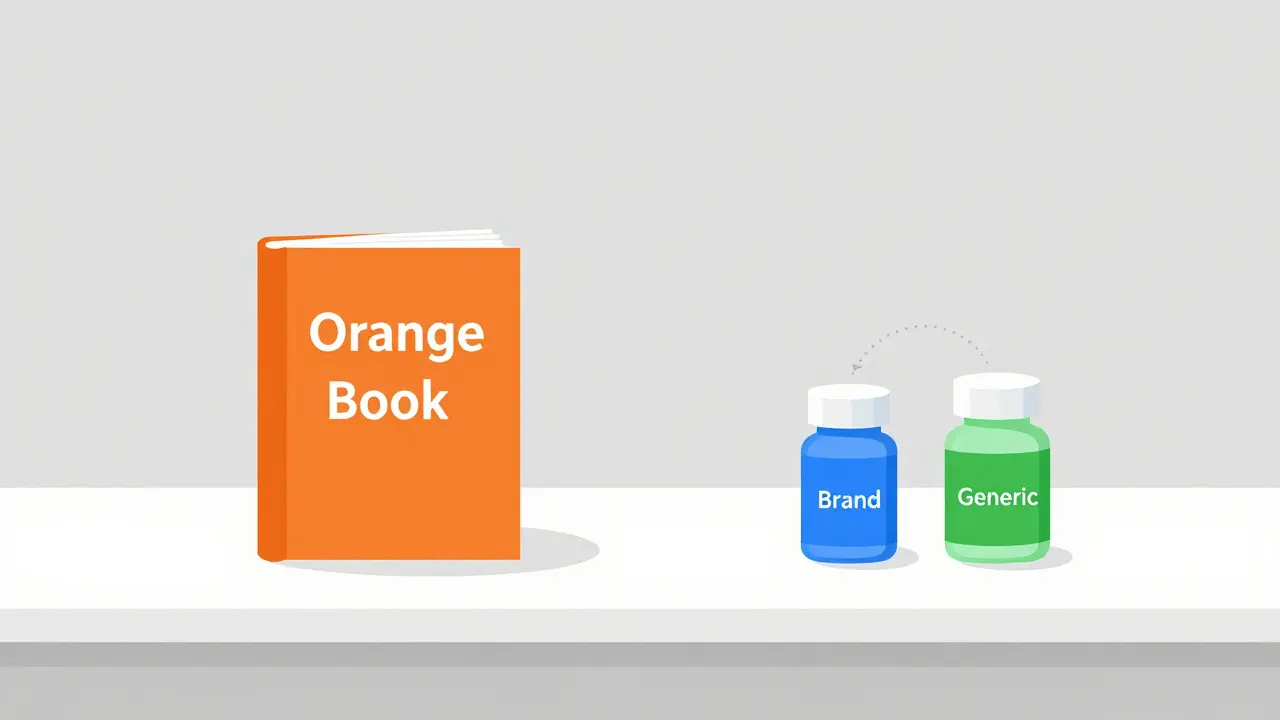
Have you ever filled a prescription for a brand-name medication and walked out of the pharmacy with a completely different-looking pill? You might have wondered if your pharmacist just grabbed whatever was on the shelf to save money. In reality, that swap is governed by a strict legal framework involving the Food and Drug Administration (FDA) and state laws. It all comes down to something called FDA therapeutic equivalency codes. These alphanumeric tags are the silent gatekeepers of your medication cabinet, determining whether a generic drug is legally and scientifically allowed to replace the original brand.
This isn't just about saving cash at the pharmacy counter. It’s about ensuring that when you take a cheaper alternative, it works exactly as well as the expensive one without causing unexpected side effects. The system relies on decades of regulatory history, complex scientific testing, and a publication known universally in the pharmaceutical industry as the "Orange Book." Understanding how these codes work helps demystify why some generics are swapped automatically while others require a doctor’s specific approval.
The Foundation: Hatch-Waxman and the Orange Book
To understand where these codes come from, we have to look back at 1984. Before this year, bringing a new drug to market was incredibly expensive and slow, and once a patent expired, there was no clear path for competitors to enter the market quickly. Congress passed the Drug Price Competition and Patent Term Restoration Act, commonly known as the Hatch-Waxman Amendments, to fix this imbalance. This legislation created a streamlined process for approving generic drugs through Abbreviated New Drug Applications (ANDAs). Instead of repeating costly clinical trials, generic manufacturers only needed to prove their product was bioequivalent to the already-approved brand-name drug, known as the Reference Listed Drug (RLD).
The FDA implemented this system through its Approved Drug Products with Therapeutic Equivalence Evaluations, famously called the Orange Book. First published in 1980 but significantly expanded after Hatch-Waxman, this book lists every approved drug product along with its therapeutic equivalence evaluation. As of October 2023, the Orange Book contained over 14,000 approved drug products. It serves as the definitive legal reference for pharmacists across all 50 U.S. states. When a pharmacist considers substituting a generic for a brand, they don’t guess; they check the Orange Book. If the code says it’s equivalent, the law usually allows the switch.
Decoding the Alphabet: A vs. B Ratings
The core of the system lies in the first letter of the TE Code. This single character tells you everything you need to know about whether the FDA considers the generic interchangeable with the brand. There are two main categories: "A" and "B."
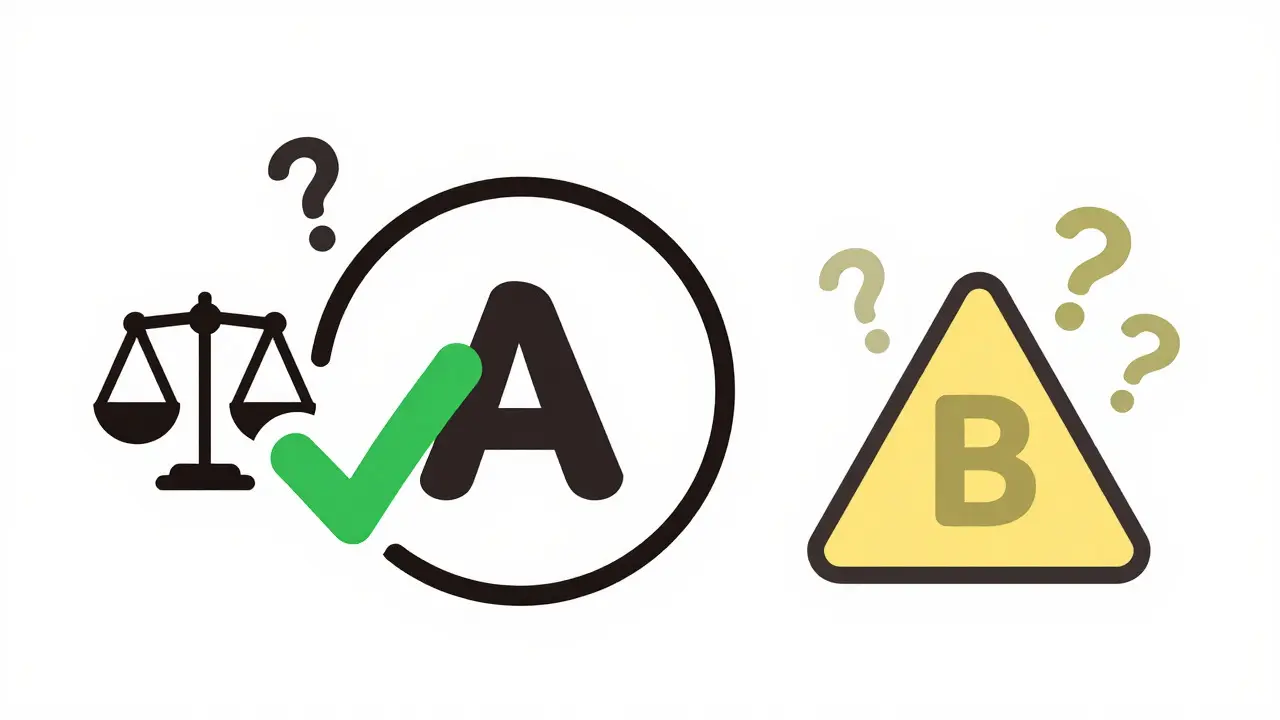
An "A" rating means the product is therapeutically equivalent. According to the FDA's glossary updated in August 2023, an "A" rated product must be a pharmaceutical equivalent-meaning it has the same active ingredient, dosage form, route of administration, and strength-and it must demonstrate bioequivalence through rigorous studies compared to the RLD. Essentially, the FDA has confirmed that the generic will produce the same clinical effect and safety profile as the brand when used as directed. This is the gold standard for substitution.
On the other hand, a "B" rating indicates that the FDA has not determined therapeutic equivalence. This doesn't necessarily mean the drug is unsafe or ineffective; rather, it means there are unresolved questions regarding bioequivalence. These issues often arise with complex dosage forms where proving equivalence is scientifically difficult. For example, topical creams, inhalers, or extended-release capsules might receive a "B" code because the way the drug is delivered makes it hard to prove it behaves identically in the body to the brand name. Pharmacists generally cannot substitute "B" rated generics unless the prescribing physician explicitly agrees, and even then, caution is advised.
| Code | Meaning | Substitutability Status |
|---|---|---|
| AA | Immediate-release oral dosage form; no bioequivalence issues. | Highly substitutable; most common generic rating. |
| AB | Initially had bioequivalence concerns but proven equivalent later. | Substitutable; considered therapeutically equivalent. |
| BC | Extended-release dosage form with potential issues. | Not automatically substitutable; requires careful review. |
| BD | Documented bioequivalence problems. | Generally not substitutable. |
| BT | Topical product with bioequivalence issues. | Low substitutability; high pharmacist reluctance. |
| BX | Insufficient data to determine equivalence. | Not substitutable until more data is available. |
How State Laws Enforce Federal Standards
While the FDA sets the scientific standards, the actual act of swapping pills happens at the state level. This creates a two-layer legal system. The FDA provides the data via the Orange Book, but state pharmacy boards write the laws that dictate what pharmacists can do with that data. Fortunately, all 50 states reference the Orange Book’s TE ratings, creating a relatively consistent national framework.
For instance, California’s Business and Professions Code Section 4073 explicitly permits substitution only for products with "A" codes. Similarly, New York State’s Office of the Professions mandates that pharmacists check the current edition of the Orange Book before substituting any generic product. This means that if a generic has a "B" code, a pharmacist in California or New York typically cannot dispense it as a substitute without contacting the prescriber. Some states allow substitution of "B" rated drugs under specific circumstances, such as if the patient consents or the doctor approves, but the default rule leans heavily toward "A" rated products for automatic swaps.
This legal structure protects patients by ensuring that substitutions are based on verified science rather than cost-cutting alone. However, it also places a burden on pharmacists to stay updated. The Orange Book is updated monthly, reflecting new approvals and reevaluations. A product might start with a "B" code due to limited data and later move to an "A" code once additional studies confirm its equivalence. Pharmacists must rely on the latest version to ensure compliance.

The Economic Impact of Generic Substitution
You might wonder why this bureaucratic coding system matters so much. The answer is money-specifically, billions of dollars in healthcare savings. According to IQVIA’s 2023 U.S. Generics Drug Savings Report, products with "A" codes generated $298 billion in savings during 2022 alone. That represents 97% of all generic drug dispensing in the United States. Without the ability to confidently substitute generics for brands, healthcare costs would skyrocket.
Dr. Lawrence Yu, former Deputy Director of the FDA’s Office of Pharmaceutical Quality, noted in a 2020 webinar that the TE code system has enabled $1.7 trillion in healthcare savings since 1995 while maintaining therapeutic outcomes. This economic benefit drives the FDA’s ongoing efforts to expand the number of "A" rated products. Currently, as of October 2023, 8,742 products carry "A" codes (62.1% of listed products), while 3,415 products have "B" codes (24.3%). The FDA aims to reduce the percentage of "B" code products to under 15% by 2027 through initiatives like the Complex Generic Drug Initiative.
However, challenges remain. The Generic Pharmaceutical Association reported in 2022 that 68% of pharmacists surveyed indicated reluctance to substitute products with "BT" (topical) codes due to perceived clinical differences. Even if a generic is approved, trust and familiarity play huge roles in real-world practice. Patients often report feeling different results with various generic versions of the same drug, particularly for medications affecting mood or pain management, although scientific studies consistently show these perceptions are often psychological rather than physiological.
Complex Drugs and Future Developments
Not all drugs are simple tablets. Complex generics include inhalers, injectables, ophthalmic solutions, and transdermal patches. Proving bioequivalence for these products is harder because the delivery mechanism affects how the drug enters the bloodstream. This is why many complex products sit in the "B" category. The FDA recognized this bottleneck and launched a digital transformation of the Orange Book in January 2023, providing API access for electronic health record systems to make checking codes easier and faster.
In August 2023, the FDA published draft guidance titled "Complex Products: Considerations for Demonstration of Therapeutic Equivalence." This document outlines new scientific methodologies to evaluate these tricky drugs, aiming to convert more "B" codes to "A" codes. The goal is to increase competition and lower prices without compromising safety. By 2028, industry analysts project that "A" coded products will account for 93% of all generic prescriptions, driven by these regulatory improvements.
Despite these advances, brand-name manufacturers sometimes challenge TE ratings. The FDA received 1,247 citizen petitions in 2022 challenging TE ratings, a 17% increase from the previous year. Most of these came from brand companies trying to delay generic competition for products with complex delivery systems. This tug-of-war between innovation, competition, and regulation ensures that the TE code system remains dynamic and constantly evolving.
What does an "A" code mean in the Orange Book?
An "A" code means the FDA considers the generic drug therapeutically equivalent to the brand-name reference listed drug. It indicates that the generic has the same active ingredient, dosage form, strength, and route of administration, and has demonstrated bioequivalence through scientific studies. Pharmacists can typically substitute these generics automatically under state laws.
Can a pharmacist substitute a generic with a "B" code?
Generally, no. A "B" code indicates that the FDA has not determined therapeutic equivalence, often due to unresolved bioequivalence issues. Most state laws prohibit automatic substitution of "B" rated products. Substitution may only occur if the prescribing physician explicitly approves it and the patient consents, depending on local regulations.
Why are some generic drugs rated "B" instead of "A"?
"B" ratings are usually assigned to complex drug products where proving bioequivalence is scientifically difficult. Examples include topical creams, inhalers, extended-release formulations, and nebulized solutions. The FDA may lack sufficient data to confirm that the generic performs identically to the brand in the body, leading to a "B" designation until further studies are completed.
How often is the Orange Book updated?
The Orange Book is updated monthly. These updates reflect new drug approvals, changes in patent status, and revisions to therapeutic equivalence codes based on new scientific evidence. Pharmacists and healthcare providers should always consult the most recent edition to ensure accurate substitution decisions.
Do over-the-counter (OTC) drugs have TE codes?
No, the FDA does not assign therapeutic equivalence codes to over-the-counter drugs. TE codes apply only to multisource prescription drug products approved under Section 505 of the Federal Food, Drug, and Cosmetic Act. OTC drugs are regulated differently and do not undergo the same therapeutic equivalence evaluation process.
Written by Felix Greendale
View all posts by: Felix Greendale