
Why Fake Drugs Remain a Crisis in 2026
You might think we have solved the problem of fake drugs are medications that mimic genuine products while lacking active ingredients or containing harmful substances. Yet, here in 2026, one in ten medical products in low- and middle-income countries is still substandard. That number doesn't sound scary until you realize it means millions of doses fail every year. We aren't just talking about sugar pills anymore. Counterfeiters are using AI and digital fabrication to copy packaging down to the microscopic level. This creates an urgent need for technology that makes forgery nearly impossible.
The fight against these threats has shifted from simple barcodes to complex digital ecosystems. Pharmaceutical companies and regulators are moving toward a world where every pill carries a verifiable identity. If you work in supply chain management or healthcare logistics, you know the pressure. By 2026, compliance is no longer optional; it is a requirement for keeping your license to operate. Let's look at the actual tools changing the game today.
The Evolution of Drug Serialization
Mass serialization has become the bedrock of modern safety. Think of this as giving every single box of medicine a passport. In 2025, this technology captured 34% of the market share. Drug Serialization involves assigning unique identifiers to each pharmaceutical unit for item-level tracking from manufacturer to end-user.
This isn't just a sticker with a number. Modern systems integrate with enterprise resource planning software and warehouse management systems. When a recall happens, companies can identify the exact batch affected within minutes instead of weeks. Data shows this reduces recall execution time by nearly 60%. For patients, this means dangerous batches stay out of pharmacies. For manufacturers, it strengthens audit capabilities significantly.
However, serialization alone is not enough. Bad actors eventually figure out how to copy the numbers. To combat this, the industry is layering multiple security types over one another. We are seeing a move from passive identification to active, cryptographic verification that smartphones can read instantly.
NFC and Smartphone Verification
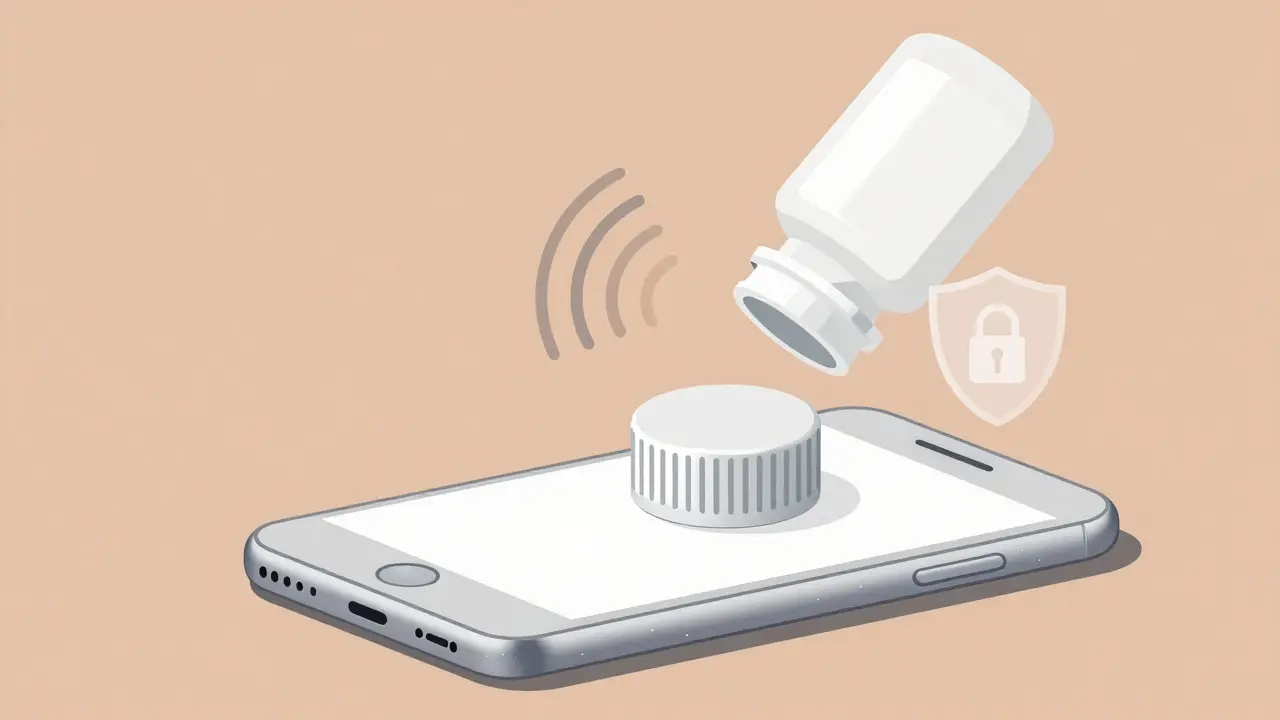
NFC Technology uses Near Field Communication chips embedded in packaging to allow contactless authentication via smartphone taps. This has become the preferred method for consumer-facing verification. In a demonstration at CPHI Frankfurt in August 2025, researchers showed cryptographically secured NFC processing authentication in under 2 seconds with 99.98% accuracy.
Why does this beat traditional QR codes? Standard QR codes can be scanned and copied easily. Research indicates that 78% of basic QR implementations fail security audits because fraudsters replicate them digitally. With NFC, the chip contains encrypted data. A phone tap reads a mathematical proof of authenticity rather than just a web link. LatAm case studies from early 2026 showed a 92% reduction in false positive rates when switching to this tech.
Adoption is rapid because the hardware already exists. 89% of global smartphone shipments in 2025 had NFC capability. Pharmacists don't need expensive scanners. They simply tap their existing devices. The user experience is frictionless, adding only three to five seconds per verification during dispensing.
| Technology | Security Level | Implementation Time | Estimated Cost Per Unit | Best Use Case |
|---|---|---|---|---|
| Standard QR Code | Low | 2-4 Weeks | $0.01 - $0.02 | Basic Traceability |
| Cryptographic NFC | Very High | 6-8 Weeks | $0.05 - $0.10 | Patient Verification |
| DNA Authentication | Ultra-High | 12+ Months | $0.15 - $0.25 | High-Value Biologics |
| RFID Tags | High | 8-10 Weeks | $0.08 - $0.12 | Logistics & Warehousing |
Blockchain and Immutable Records
Blockchain creates a decentralized, tamper-proof ledger for recording product movement and condition data. While initially hyped, its practical application in pharma has matured by 2026. Platforms adapted from industries like diamond trading are now tracking temperature and humidity alongside movement.
Each product gets a unique digital identity on the blockchain. As it moves through the supply chain, participants record its presence and condition. This creates a cold chain record that cannot be altered without detection. Gartner estimates that full enterprise integration takes 18 to 24 months, which is slower than standard serialization.
The benefit lies in trust between parties who don't know each other. A hospital receiving a shipment can verify its entire history without asking the distributor directly. This transparency helps meet rigorous audit demands and prevents the diversion of drugs from approved markets into unauthorized channels.
Biological Markers and DNA Auth
For the highest security needs, nothing beats biology. DNA-based authentication incorporates unique biological markers into the tablet or packaging material. You need specialized testing to verify them, making replication nearly impossible for standard criminals. Implementation costs range from $0.15 to $0.25 per unit, compared to $0.02 for standard methods.
This technology is currently reserved for high-value biologics and critical emergency medications where the margin for error is zero. Companies are integrating these forensic markers alongside overt features like holograms. Experts suggest that combining these invisible layers with visible markings provides the strongest defense against sophisticated forgery operations.
Regulatory Pressure Driving Adoption
Laws matter more than technology itself. Without mandates, many companies would prioritize profit over security. Two major drivers have reshaped the landscape by 2026:
- U.S. Drug Supply Chain Security Act (DSCSA): The November 2025 deadline for unit-level traceability has passed. This law requires product information to travel down to the pharmacy level. Penalties for non-compliance are severe, pushing even smaller distributors to upgrade systems rapidly.
- EU Falsified Medicines Directive (FMD): European regulations mandate tamper-evident packaging and verification systems. In 2025 alone, implementation projects in Europe cost approximately €2.3 million for major distributors, yet they were essential to maintain market access.
We also saw disruptions from the April 2025 "Liberation Day Tariffs" affecting trade with China and India. Tariffs ranging from 10% to 46% increased production costs by up to 18% and caused delays of 45 days in some supply chains. This volatility forced companies to accelerate digital solutions to track inventory more tightly and mitigate stockouts caused by border holds.
Challenges in Real-World Implementation
Tech looks good on paper, but installation reveals grit. A warehouse manager noted in mid-2025 that initial throughput dropped by 37% during system rollout. Staff need training; basic serialization takes 6-8 weeks, while blockchain systems demand nearly four months of specialized learning.
Legacy equipment is a bottleneck. Many older printers and scanners struggle to interface with cloud-based verification platforms. Support quality varies wildly between vendors. Top-tier providers offer 24/7 help with an average 8-minute response time, while lower-cost options may leave you waiting for days. Documentation is also uneven; some Chinese RFID suppliers offer minimal technical support compared to Western counterparts.
The Path Ahead
The market for anti-counterfeit packaging is projected to reach USD 345.93 billion by 2030. This growth signals a permanent shift. We are moving away from reliance on visual inspection alone. Instead, we are building a connected ecosystem where every box speaks its true history.
Sustainability is also entering the mix. 62% of new packaging solutions now incorporate recyclable materials alongside security features. The goal is no longer just safety, but eco-friendly safety. As 2026 progresses, expect further consolidation among vendors. Analysts predict 30-40% of current players will be acquired by 2028 as the market matures around the dominant leaders.


Written by Felix Greendale
View all posts by: Felix Greendale