
Generic drugs used to be simple. Copy a brand-name pill, prove it works the same, and sell it for a fraction of the price. That model is fading. Today, the real action in generics isn’t in plain tablets-it’s in generic combinations. These aren’t just copies anymore. They’re smarter, more complex, and designed to solve real problems patients face: taking too many pills, side effects, poor absorption, or inconsistent dosing. The future of generics isn’t about being cheap-it’s about being better.
What Exactly Are Generic Combinations?
Generic combinations are medicines that combine two or more active ingredients into a single dosage form, often with a new delivery method. Think of them as upgraded generics. They include:- Fixed-dose combinations (FDCs): Two or more drugs in one pill, like a blood pressure pill with an ACE inhibitor and a diuretic.
- Drug-device combinations: Inhalers, auto-injectors, or patches that deliver drugs more reliably-like generic versions of EpiPen or inhalers for COPD.
- Modified-release formulations: Extended-release pills that last longer, reducing how often patients need to take them.
- Super-complex combinations: Advanced systems like nanoparticle-based delivery or multi-component systems that target specific tissues.
These aren’t just copies of branded drugs. They’re engineered to improve how the drug works in the body. For example, a generic version of a complex inhaler might use a better propellant or a more precise dosing mechanism to ensure patients get the full dose every time. That’s not luck-it’s science.
Why the Market Is Exploding
The global market for these advanced generics-often called super generics-is projected to grow from $235.6 billion in 2025 to $474.6 billion by 2035. That’s a 7.2% annual growth rate. Why now?Because hundreds of billions in branded drug sales are losing patent protection between 2025 and 2030. Drugs like Trelegy Ellipta (for asthma/COPD, $2.8 billion in 2024 sales) and Austedo (for movement disorders, $1.2 billion) are sitting ducks for smart generic manufacturers. But here’s the catch: the easiest generics-like statins or blood pressure pills-are already flooded with competition. Prices have dropped 80-90% in two years. Margins are near zero.
Super generics are the escape route. They avoid the race to the bottom. Take bupropion, an antidepressant. The plain generic version sells for pennies. But Teva’s extended-release version, Budeprion XL, brought in $187 million annually before competitors entered. That’s nearly five times the revenue of all the simple generics combined. The same pattern plays out in oncology, CNS disorders, and respiratory diseases.
Regulatory Hurdles Are Higher-But So Are Rewards
Getting approval for a plain generic takes about 2-3 years and costs $1-5 million. You submit an ANDA (Abbreviated New Drug Application), prove bioequivalence, and you’re done.For a complex combination? It’s a different game. You need 30-50% more clinical data. Approval can take 18-24 months longer. The FDA treats these as combination products under 21 CFR Part 4, which means they’re reviewed by the Office of Combination Products. That office decides whether the drug or the device is the primary mode of action-and that determines which division handles the review.
And it’s not just paperwork. You need precision manufacturing. For a combination pill, the ratio of ingredients must be within ±2% tolerance. For inhalers, the spray pattern and particle size must match the original. Dissolution profiles must match within 10% f2 similarity. If you miss that, your product gets rejected.
According to the Regulatory Affairs Professionals Society, 78% of failures in complex generics come from flawed delivery systems-not the active ingredient. That’s a big deal. It means companies are spending millions developing the right chemistry, only to fail because the delivery mechanism doesn’t behave like the brand.

Price Retention: The Real Advantage
Plain generics lose value fast. Within two years, they’re priced at 90% below the brand. Super generics? They hold on.IQVIA’s 2025 analysis shows that complex combinations retain 40-60% of their launch price five years after entry. Compare that to the 5-10% margins of simple generics. Super generics can hit 20-35% margins. Why? Because they’re not interchangeable. They offer real improvements: fewer pills per day, fewer side effects, better absorption. Patients and doctors notice. Payers are willing to pay more if outcomes improve.
Take the GLP-1 market. Semaglutide (Ozempic, Wegovy) is a $100+ billion drug. Generic versions are coming-but not plain ones. Companies like Aspen Pharmacare are developing fixed-dose combinations of semaglutide with metformin or SGLT2 inhibitors. These won’t just be cheaper. They’ll be better. And they’ll command premium pricing.
Regional Differences: US vs. EU
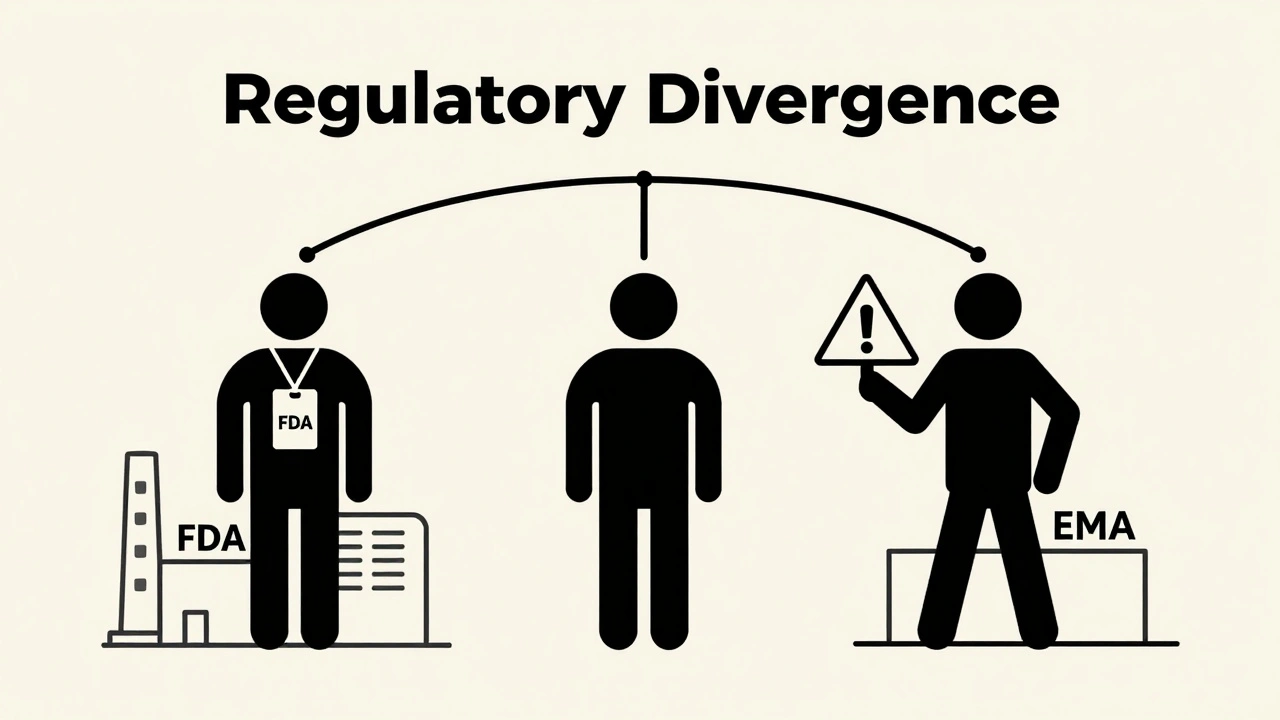
The US is leading. The FDA has been more open to innovation in generics. By Q1 2025, the US had approved 37 complex generic combinations. The European Medicines Agency (EMA) had approved just 12.Why? The EMA is more cautious. They demand stricter proof of therapeutic equivalence, especially for drug-device products. The FDA, meanwhile, launched a pilot program in October 2025 to fast-track reviews for generic combinations made entirely in the US. That’s a clear signal: they want these products here, and they’re willing to move faster to get them.
This creates a strategic gap. Companies that can navigate both systems will dominate. But for now, the US is the main prize. India, meanwhile, is becoming the manufacturing hub-producing 35% of the world’s complex generics. But most of those are shipped to the US, not sold locally.
Who’s Winning?
The players aren’t the same as they were five years ago. Sandoz split from Novartis to focus purely on complex generics. Viatris and Credence merged for $2.3 billion in Q2 2025 specifically to build scale in this space. Teva, Mylan, and Aspen are all investing heavily in modified-release tech and device partnerships.Device manufacturers are jumping in too. Catalent is working with Hikma on auto-injectors. Companies that once made syringes and inhalers are now co-developing drug-device combos with pharma firms. This isn’t just supply chain-it’s R&D collaboration.
What’s Next?
Three trends are clear:- Complexity is the new premium. Products with multiple innovations-say, an extended-release FDC delivered via a smart inhaler-can command 2-3x the price of a simple generic.
- Regulatory divergence will grow. The US will keep pushing boundaries. The EU and other regions will lag. Companies will need regional strategies.
- Partnerships will replace solo efforts. No single company has all the skills anymore. You need formulation scientists, device engineers, and manufacturing experts working together.
The long-term goal? Shift from volume to value. Generics now make up 90% of US prescriptions but only 20% of spending. That’s unsustainable. To survive, generic companies must move up the value chain. Super generics aren’t optional-they’re the only path to profitability.
By 2030, super generics could capture 35-40% of the total generics market value. That’s not speculation. It’s math. With $217-236 billion in branded drugs losing exclusivity over the next five years, the opportunity is too big to ignore. The question isn’t whether generic combinations will dominate-it’s who will build them first.
Challenges Ahead
It’s not all smooth sailing. IQVIA warns that pricing pressure could erode margins across the board by 30% over the next decade. If too many companies enter the same complex space-say, five firms launching similar inhaler combos-the market could collapse into a new price war.There’s also a scientific gap. Harvard’s Dr. Aaron Kesselheim wrote in NEJM 2025 that the standard for therapeutic equivalence in complex generics is still poorly defined. What does “equivalent” mean when you’re dealing with nanoparticles or precision inhalers? The FDA is working on it, but regulators are playing catch-up.
And then there’s manufacturing. Not every plant can handle hot-melt extrusion or lipid-based delivery systems. The equipment is expensive. The training is specialized. That’s why only a handful of companies are truly competitive.
Final Thought: It’s Not About Being Cheap Anymore
The old generic business model-copy, cut price, sell volume-is dead. The future belongs to those who can engineer better outcomes. A patient taking one pill instead of three. A COPD patient getting the full dose every time. A diabetic avoiding a second injection.Generic combinations aren’t just products. They’re solutions. And in a healthcare system drowning in complexity, that’s the most valuable thing a generic company can offer.


Written by Felix Greendale
View all posts by: Felix Greendale