
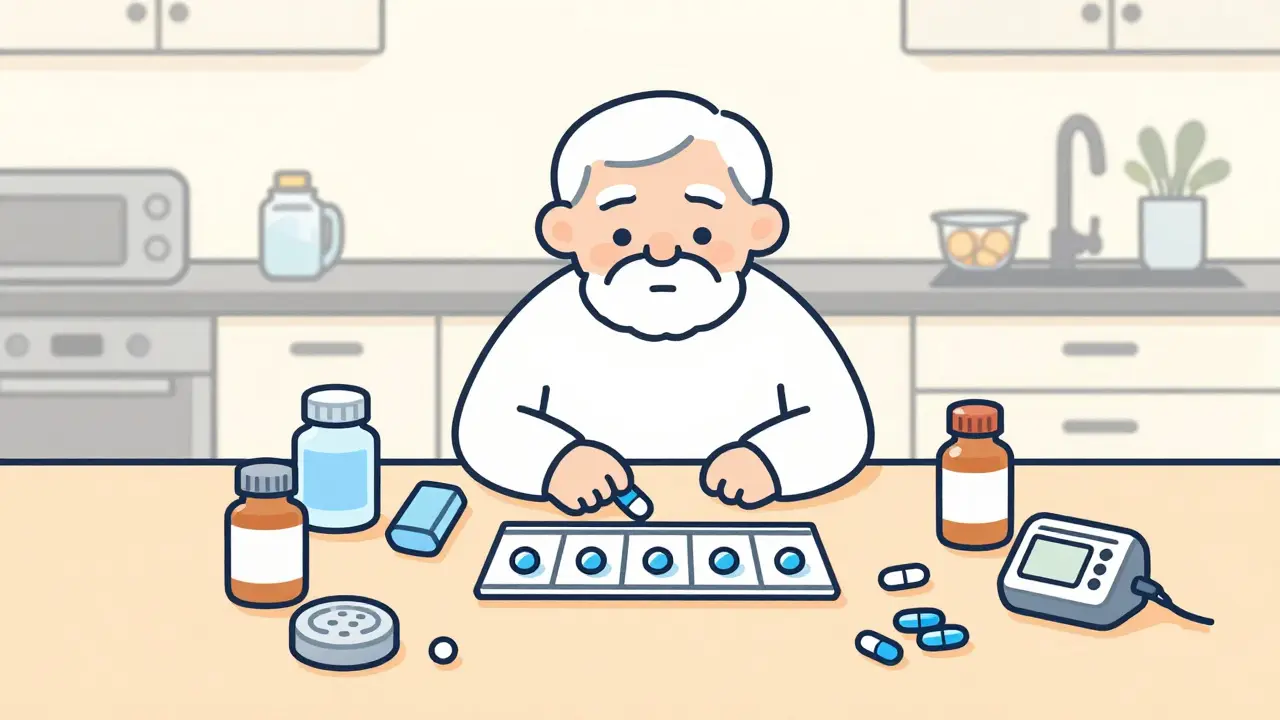
Imagine taking eight different pills at four different times a day-some with food, some on an empty stomach, others at bedtime. Now imagine doing that every single day, with shaky hands, fading memory, and no one to remind you. This isn’t rare. It’s the daily reality for many older adults in the UK and beyond. With 40% of people over 65 taking five or more medications, the burden isn’t just physical-it’s mental, emotional, and deeply personal. The good news? You don’t have to live like this. Simplifying medication regimens isn’t about cutting corners. It’s about making treatment work for the person, not the other way around.
Why Medication Regimens Get So Complicated
Older adults often see multiple specialists-cardiologists, endocrinologists, neurologists-each prescribing what they believe is best. A blood pressure pill here, a diabetes tablet there, an antidepressant, a painkiller, a statin, maybe a sleep aid. Each prescription makes sense on its own. But together? They create a tangled web. By the time all the doses are staggered, timing rules are added, and side effect warnings are noted, a simple list becomes a full-time job.Studies show that nearly 60% of older adults living at home have regimens with five or more daily doses. And here’s the kicker: the more pills someone takes, the less likely they are to take them correctly. One 2020 study found that people taking more than four medications daily were twice as likely to miss doses. Missed doses don’t just mean symptoms return-they lead to hospital visits, falls, confusion, and worse.
The Three Ways to Simplify Medication Regimens
Simplification isn’t guesswork. It’s a proven, structured process with three main tools:- Fixed-dose combinations: Instead of two separate pills, one pill does both jobs. For example, switching from separate lisinopril and hydrochlorothiazide tablets to a single pill containing both. This cuts pill count and reduces confusion.
- Once-daily dosing: Many medications now come in long-acting forms. A blood pressure pill taken twice a day can often be switched to a single daily dose that lasts 24 hours. Same for some antidepressants, diabetes meds, and even certain antibiotics.
- Combining both: The most powerful approach. Reduce the number of pills and the number of times you take them. For instance, replacing three daily pills with one morning tablet and one evening tablet. That’s a 50% reduction in administration points.
These aren’t theoretical ideas. In a 2020 trial across 1,500 older adults in the US, 41% of medication regimens were successfully simplified using these methods. And in Australian aged care homes, pharmacists using the MRS GRACE tool simplified regimens for 58-60% of residents-without worsening health outcomes.
What Works Best for Which Medications
Not all drugs respond the same way to simplification. Some have strict timing rules that can’t be bent.- Antihypertensives: Many can be switched to once-daily versions. However, some diuretics still need morning dosing to avoid nighttime bathroom trips.
- Diabetes medications: Metformin and some SGLT2 inhibitors often work well in once-daily forms. But insulin? That’s trickier. Long-acting insulins like glargine can be simplified, but rapid-acting ones usually need to be timed with meals.
- Statins: These are ideal candidates. Most work best at night, but newer versions can be taken anytime-making them easy to combine with other evening meds.
- Thyroid hormone (levothyroxine): Must be taken on an empty stomach, 30-60 minutes before breakfast. This timing can’t be moved. But if it’s the only morning pill, it becomes a simple anchor point for the rest of the regimen.
- Antipsychotics and antidepressants: Many now come in once-daily formulations. Studies show simplified regimens here improve adherence and even reduce agitation in dementia patients.
There’s a catch: simplifying doesn’t always mean better health outcomes. A 2020 review of 12 studies found that while 83% of simplifications improved adherence, only half led to measurable clinical improvements like lower blood pressure or fewer hospital stays. Why? Because adherence is just one piece. Sometimes, the original regimen was already working fine-just hard to follow. Simplification makes it easier to stick with, but doesn’t fix underlying disease.

The Five-Step Process That Works
Simplification isn’t a quick swap. It’s a careful, step-by-step review. Here’s how it’s done right:- Get the full picture: Start with a “best possible medication history.” That means collecting every pill, supplement, and over-the-counter drug the person takes-even the ones they forgot about or stopped taking. Pharmacists often find six or more discrepancies between what the GP thinks is being taken and what’s actually in the medicine cabinet.
- Check if each drug is still needed: This is called deprescribing. Maybe the statin was prescribed five years ago for borderline cholesterol, and now it’s no longer needed. Maybe the sleep aid is causing morning dizziness. Not every pill is a keeper.
- Look for combination pills: Are there two separate pills that could be replaced by one? Ask the pharmacist. Many combinations exist for heart disease, diabetes, and mental health.
- Switch to once-daily versions: Not all drugs have them-but many do. Ask: “Is there a long-acting version?” Don’t assume the current form is the only option.
- Align with daily life: Can the doses be grouped around meals, bedtime, or a nurse’s visit? If someone eats breakfast at 8 a.m. and has a home visit at 3 p.m., build the regimen around those anchors. Simplicity means fitting into real life, not forcing life to fit the pill schedule.
The MRS GRACE tool, developed in Australia, is a simple five-question checklist used by pharmacists to guide this process. It’s not magic-but it’s structured. And it works.
Real-Life Impact: What Happens When You Simplify
In one care home in Brighton, staff used the MRS GRACE tool to review 25 residents’ medications. Before: an average of 6.8 daily doses per person. After: 3.1. That’s a 54% reduction. Medication errors dropped by 30%. Staff reported less stress. Residents said they felt “less like a pharmacy” and more like themselves.One woman, 82, was taking 11 pills a day-some with food, some without, some at night. She was confused, missed doses, and kept falling. After simplification: four pills, all taken at breakfast and bedtime. Her daughter said, “I finally feel like I can help her again.”
Another man, 78, had hypertension and type 2 diabetes. His regimen included five pills at three different times. He’d often forget the afternoon dose. Switched to two combination pills-one morning, one evening. His blood pressure improved. His HbA1c stayed stable. And he stopped calling the pharmacy every week asking if he took his pills.
Who Should Do This-and When
This isn’t something to do alone. You need a pharmacist, a GP, or a geriatric specialist. But you can start the conversation:- Ask your pharmacist: “Can any of these pills be combined or switched to once-daily?”
- Ask your doctor: “Is every medication still necessary? Are there alternatives with fewer doses?”
- Bring a full list of all medications-including vitamins, supplements, and herbal remedies-to every appointment.
- Use a pill organizer-but don’t rely on it alone. It’s a tool, not a solution.
Don’t wait for a crisis. If someone is struggling to keep up with their meds-even if they’re not missing doses-it’s time to talk. The goal isn’t to reduce pills for the sake of it. It’s to reduce burden. To give back time. To let people live, not just manage.
Barriers and What’s Changing
The biggest obstacle? Time. A full medication review with simplification can take 45-60 minutes. Most GP appointments are 10. Pharmacists are stretched thin. But things are shifting.In the UK, the NHS is slowly rolling out Medication Reviews for older adults. In Australia, the government funds pharmacist-led simplification in aged care. In Germany, pharmacists get paid extra for doing it. In the US, Medicare Advantage plans now incentivize simplification to cut hospital readmissions.
Technology is helping too. Electronic health records now include tools that flag high pill burdens and suggest combinations. The University of Sydney is testing an AI tool that predicts which regimens are most likely to benefit from simplification. And more pharmacy schools are teaching geriatric pharmacology-not just as an elective, but as core training.
What You Can Do Today
You don’t need to wait for a system change. Start here:- Write down every medication, supplement, and herbal remedy your loved one takes-name, dose, time, reason.
- Take that list to their pharmacist. Ask: “Can this be simplified?”
- Ask if any meds can be switched to once-daily or combination versions.
- Check if any meds can be stopped. Don’t assume they’re all needed.
- Use a simple calendar or app to track when doses are taken. Not to punish, but to spot patterns.
Simplification isn’t about taking fewer pills. It’s about taking the right pills, the right way, at the right time-and making space for life to happen in between.
Can I just stop a medication if it seems unnecessary?
No. Never stop a medication without talking to a doctor or pharmacist. Some drugs, like blood pressure or seizure meds, can cause serious rebound effects if stopped suddenly. Even if a pill seems unimportant, it may be protecting against something you don’t see. Always review with a professional first.
What if my loved one refuses to simplify their meds?
It’s common. People worry that fewer pills means less care. Start by asking why they’re attached to certain meds. Maybe they’ve been taking them for 20 years and feel safer with them. Listen. Then explain that simplification isn’t about removing treatment-it’s about making it easier to follow. Show them how many fewer pills they’d take daily. Offer to go with them to the pharmacist. Sometimes, hearing it from a neutral expert makes the difference.
Do combination pills have more side effects?
No. Combination pills contain the same active ingredients as the separate pills-they’re just packaged together. The dose doesn’t change. Side effects come from the drugs themselves, not how they’re combined. In fact, fewer pills mean fewer chances for interactions or confusion.
How do I know if simplification is working?
Look for signs: fewer missed doses, less confusion about when to take pills, fewer pharmacy calls, better sleep, less dizziness. Ask your loved one how they feel-do they have more energy? Are they more confident? These are real indicators. Blood pressure or glucose levels may not change, but quality of life often does.
Is this covered by the NHS or insurance?
In the UK, the NHS offers a free Medicines Use Review (MUR) for people taking multiple medications. Ask your pharmacist if they offer this. It’s a 10-15 minute session to review your meds and suggest simplifications. In some areas, community pharmacists can also do home visits for older adults. Insurance plans in the US and Germany often reimburse pharmacists for these reviews-so ask if it’s available where you live.
What’s Next?
The world is aging. By 2050, there will be 1.5 billion people over 65. That means millions more people juggling complex medication regimens. The solution isn’t more pills-it’s smarter ones. Simpler schedules. Better conversations. And systems that put the person, not the protocol, first.If you’re helping someone older manage their meds, you’re already doing something vital. Now, take one more step: ask if their regimen can be simplified. That one question might give them back hours of their day-and peace of mind.


Written by Felix Greendale
View all posts by: Felix Greendale