
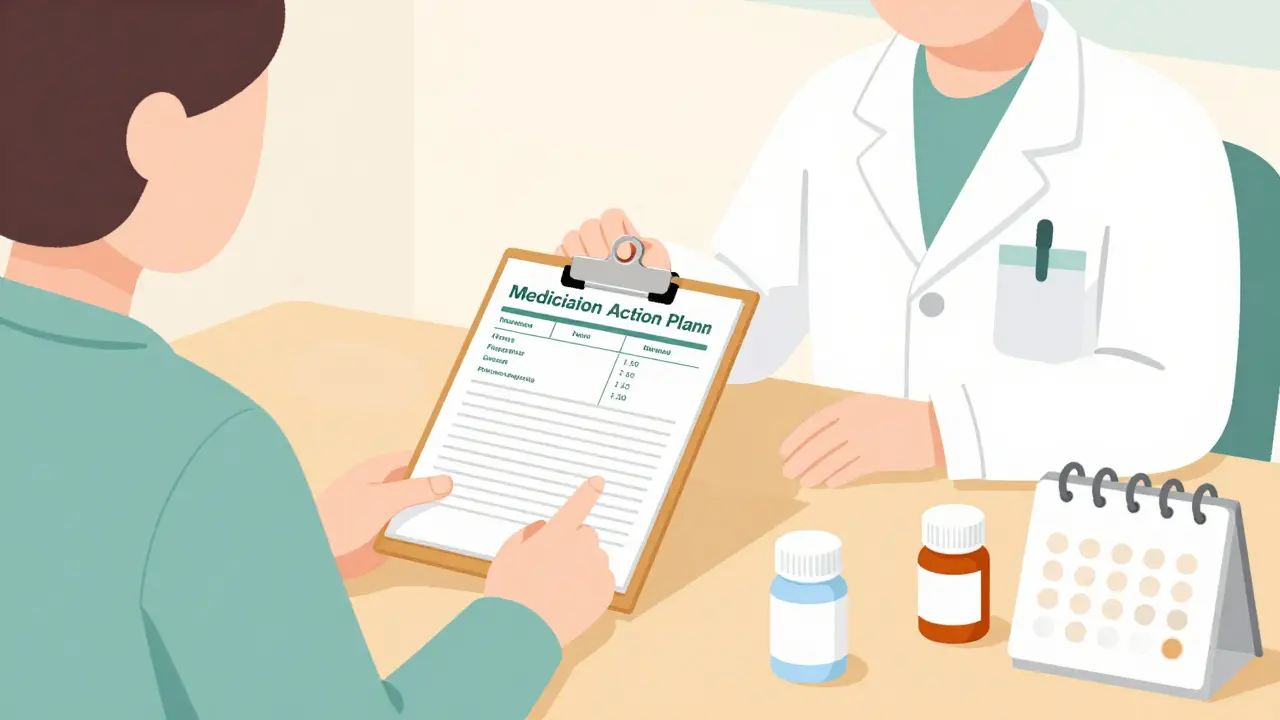
Bringing a medication action plan to your doctor’s visit isn’t just paperwork-it’s a lifeline. Every year, over 150,000 preventable medication errors happen in the U.S. alone. Many of them occur because patients and providers aren’t on the same page about what’s being taken, why, and when. A simple, filled-out Medication Action Plan (MAP) can cut those errors in half. But only if it’s used right.
What Exactly Is a Medication Action Plan?
A Medication Action Plan is a structured, standardized form that captures your current medications, your goals, what you’re supposed to do, and what to watch for. It’s not just a list. It’s a conversation starter, a memory aid, and a safety net-all in one sheet.The format was officially standardized by the Centers for Medicare & Medicaid Services (CMS) in 2023 under form CMS1245776. It’s required for Medicare Part D Medication Therapy Management (MTM) programs, but it’s useful for anyone taking three or more medications-whether you’re on Medicare or not.
In Germany, a similar plan has been mandatory since 2016 for patients on three or more prescriptions. Studies show that 87.5% of patients could find critical info on their first try using the template. That’s because it’s designed to be clear, consistent, and patient-centered.
The Five Essential Sections of a Medication Action Plan
Not all templates are the same, but the best ones share these five core sections:- What We Talked About - This is where your provider writes down what was discussed: new diagnoses, side effects noticed, or changes in health goals. Example: “Patient reports dizziness after starting lisinopril. Consider dose reduction.”
- What I Need to Do - This is the action part. Vague instructions like “take as directed” fail. Specific ones like “Take metformin 500mg with breakfast and dinner, starting tomorrow” increase adherence by 34%.
- What I Did and When I Did It - A simple tracker for pills taken or skipped. Use checkmarks, X’s, or a calendar grid. Pharmacists spend an average of 3.7 minutes reviewing this section during visits.
- My Follow-Up Plan - Includes dates for next appointments, lab tests, or when to call the doctor. Also has a space for “Questions I Want to Ask.” Write them down before you go.
- Medication List - Full names (brand and generic), doses, frequency, purpose, and start/stop dates. Never leave out over-the-counter drugs, vitamins, or supplements. They’re part of your regimen too.
According to the CDC’s MyMedications Action Plan (2021), every template must include your full name, the date it was prepared, and your provider’s contact info. Without these, it’s not a valid plan.
How to Prepare Before Your Visit
Don’t wait until you’re in the exam room to figure this out. Start three days before your appointment.- Collect every pill bottle, patch, inhaler, and liquid you’re using-even the ones you haven’t taken in months.
- Cross out any meds you stopped, and write the date and reason: “Stopped ibuprofen on 12/15/2025-stomach upset.”
- Write down any new symptoms: “Felt lightheaded after walking upstairs,” or “Sleeping more than usual.”
- Fill out the “What I Did” section honestly. If you missed three doses last week, say so. Your provider needs to know.
- Print a copy of your MAP and bring it. Also bring the physical meds. Research shows bringing bottles improves accuracy by 37.2% compared to just telling your doctor.
Pro tip: Keep a laminated wallet-sized version. Many elderly patients lose their papers. A durable copy fits in a purse or wallet and survives spills, drops, and long waits in clinics.
How to Use It During the Visit
Your provider should spend the first 5-7 minutes reviewing your MAP. Don’t let them skip it.- Hand them the plan first. Say: “I filled this out before coming. Can we go over it together?”
- Point to the “What I Did” section. Say: “I missed my blood pressure pill twice last week because I ran out.”
- Ask them to update the plan right then. If they prescribe a new drug, have them write the start date and why. If they discontinue one, make sure the stop date is recorded-not just “stopped.”
- Use the “Questions I Want to Ask” section. If you didn’t write anything down, you’ll forget half of them. Common questions: “Is this new pill safe with my other meds?” or “What should I do if I feel dizzy?”
- For older adults, ask specifically about fall risk. The AHRQ recommends spending 8-12 minutes reviewing medications that cause dizziness, low blood pressure, or confusion.
One patient in Ohio, Mary Thompson, says: “When I started bringing my MAP to every appointment, my cardiologist caught I was taking two blood pressure meds that shouldn’t be together. That stopped a hospitalization.”
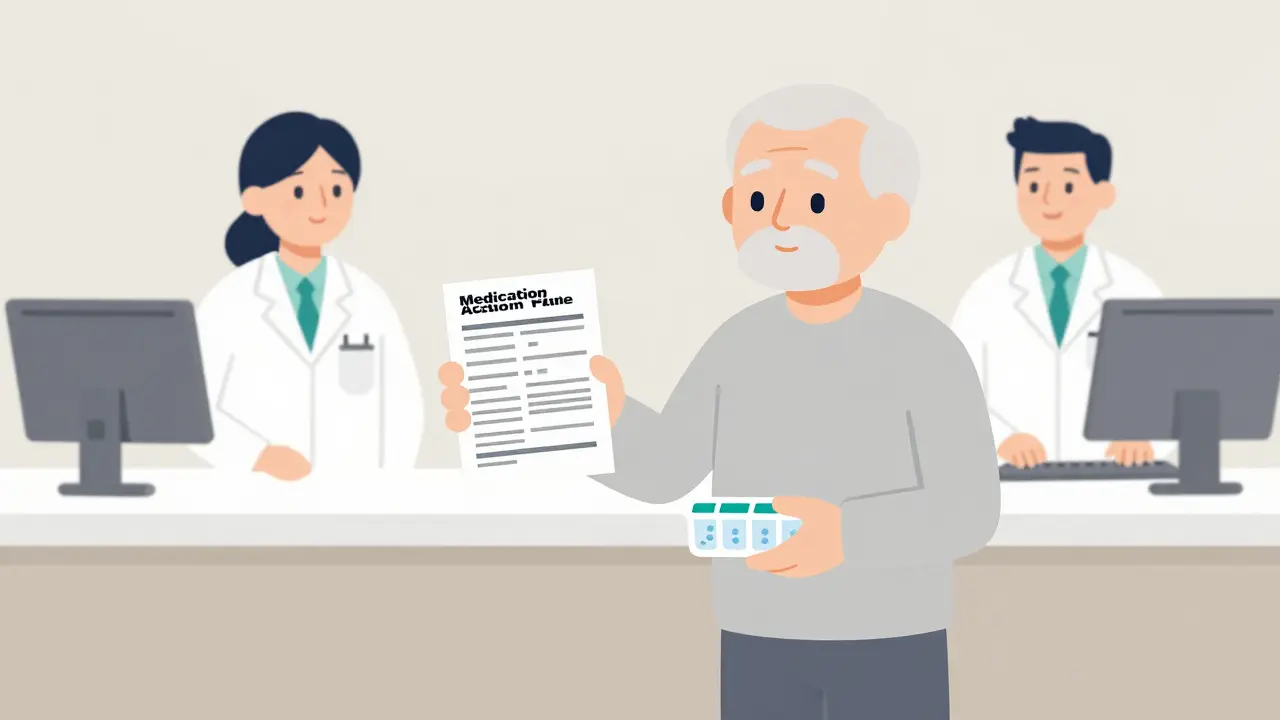
What Happens After the Visit
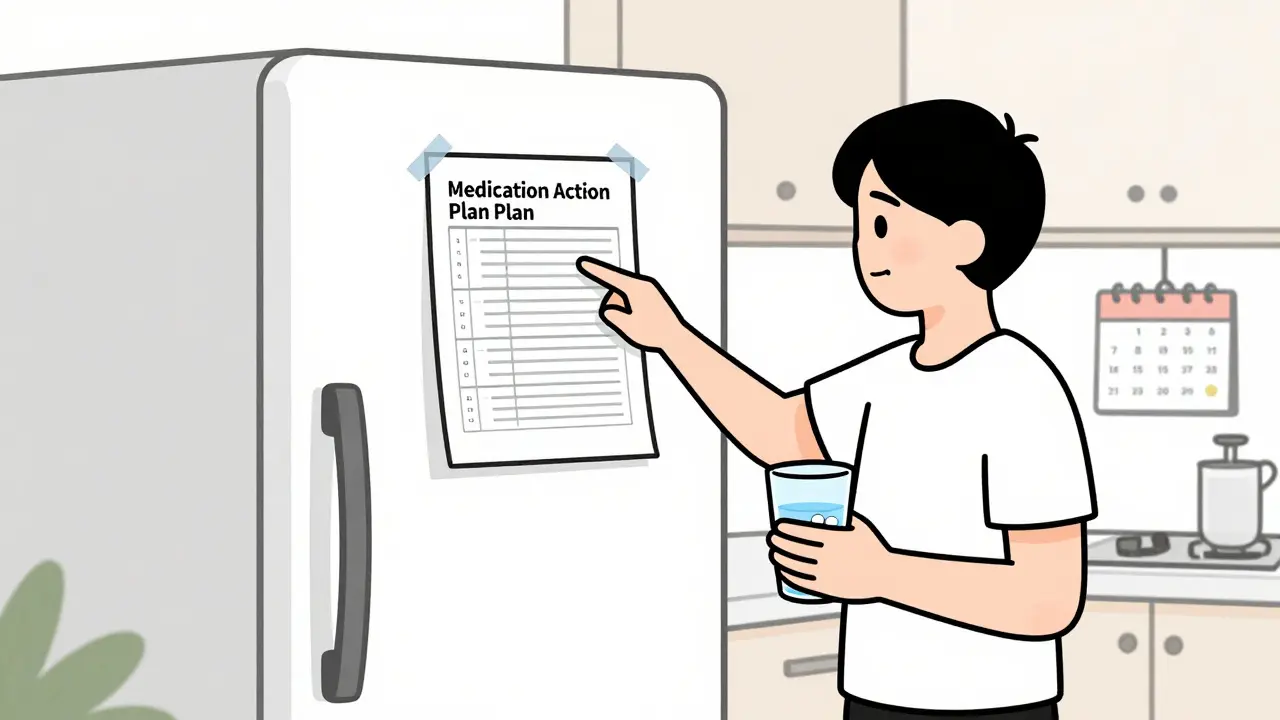
The plan isn’t done when you leave the office. It’s just getting started.- Take the updated MAP home and keep it in a visible spot-on the fridge, next to your pill organizer, or taped to your bathroom mirror.
- Give a copy to a family member or caregiver. If you forget something, they can remind you or speak up for you.
- Take it to every other provider: your pharmacist, urgent care, emergency room. The CDC says bringing your MAP to the ER reduces medication errors by 41%.
- Update it every time you get a new prescription or stop one. Don’t wait for your next appointment.
Patients who shared their MAP with multiple providers had 22.8% fewer duplicate prescriptions, according to NIH research. That’s because everyone sees the same list-no guessing, no assumptions.
Common Mistakes and How to Avoid Them
Even with the best template, people mess up. Here’s what goes wrong-and how to fix it:- Mistake: Not writing stop dates. Fix: If a med is discontinued, the plan must say “Stopped: 1/5/2026-no longer needed.” Just writing “discontinued” is not enough. This causes 18.7% of reconciliation errors.
- Mistake: Using only brand names. Fix: Write both: “Lisinopril (Zestril) 10mg once daily.” Generic names are what pharmacies use.
- Mistake: Skipping OTCs and supplements. Fix: Aspirin, fish oil, melatonin, and turmeric all interact. List them all.
- Mistake: Not teaching the patient how to use it. Fix: If your pharmacist or provider doesn’t explain the form, ask: “Can you walk me through how to fill this out next time?” Studies show patients who got 5+ minutes of training updated their plan correctly 78% of the time.
- Mistake: Thinking it’s a one-time thing. Fix: Treat it like a living document. Update it after every change-even a small one.
Why This Matters More Than You Think
Medication errors are the leading cause of preventable harm in healthcare. The Agency for Healthcare Research and Quality says proper use of MAPs can reduce adverse drug events by up to 23%. That’s not a small number. That’s lives.Community pharmacies use MAPs in 89.7% of cases. Primary care clinics? Only 62.4%. Specialty practices? Just 43.8%. That gap is dangerous. If your doctor doesn’t use it, bring it anyway. Ask for it. Demand it.
Dr. Jerry Fahrni of the National Association of Chain Drug Stores says: “The single most effective intervention in reducing medication-related hospitalizations is the consistent use of a standardized Medication Action Plan during every provider encounter.”
It’s not about bureaucracy. It’s about survival.
What If Your Provider Doesn’t Use It?
You don’t need permission to use your own plan. You just need to be prepared.- Print the CDC’s free MyMedications Action Plan template. It’s available online and free to use.
- Bring it to every visit, even if they say, “We don’t use those.”
- Politely say: “I’ve found this helps me remember what to take and what to ask. Can we use it today?”
- If they refuse, ask: “Can I email you a copy after the visit so you can add it to my chart?”
Many providers will say yes once they see how it saves time and reduces confusion. One pharmacist on Reddit said: “I’ve started asking patients to bring their MAPs. Now I spend less time asking, ‘What meds are you on?’ and more time helping them.”
Where to Get a Free Template
You don’t need to buy one. These are trusted, free, and ready to use:- CDC’s MyMedications Action Plan - Updated in 2021. Includes all required fields. Download at cdc.gov/medicationplan
- CMS CMS1245776 Template - Official Medicare version. Used by MTM providers nationwide.
- PharmCompliance Free Sample - Offers a basic version for personal use (not for commercial distribution).
Don’t wait for your doctor to give you one. Print it today. Fill it out tonight. Bring it next time.
Do I need a Medication Action Plan if I only take one or two medications?
Even if you take just one or two meds, a Medication Action Plan helps. It keeps track of why you’re taking them, what side effects to watch for, and when to call your doctor. It’s especially useful if you see multiple providers or if you’re over 65. Medication errors don’t care how many pills you take-they happen with one too.
Can I use a digital version instead of paper?
Yes, but with caution. Many apps and EHRs have medication lists, but they’re not the same as a Medication Action Plan. A true MAP includes action steps, patient goals, and follow-up plans-not just a list. If you use a digital tool, make sure it includes all five sections. And always bring a printed copy to your visit. Not all clinics can access your app.
What if I can’t read or understand the plan?
You’re not alone. Only 12% of U.S. adults have proficient health literacy. Ask your provider or pharmacist to go over it with you in person. Request a simplified version with icons or pictures. Some clinics offer translated or pictorial MAPs. You can also ask a family member to help you fill it out and explain it back to you.
How often should I update my Medication Action Plan?
Update it every time you start, stop, or change a medication-even if it’s just a new dose. Don’t wait for your next appointment. Also update it if you have a new symptom, a hospital visit, or a pharmacy change. The plan should always reflect your current reality.
Can I use this plan in the emergency room?
Absolutely. The CDC recommends bringing your Medication Action Plan to every ER visit. In an emergency, staff may not have time to ask detailed questions. Your MAP gives them a clear, accurate picture of your meds-fast. This can prevent dangerous interactions or duplicate prescriptions.
Next Steps: Start Today
Here’s what to do right now:- Go to cdc.gov/medicationplan and download the free template.
- Print two copies-one for you, one for a family member.
- Gather all your medications: pills, patches, inhalers, vitamins.
- Fill out the plan honestly-include everything, even the stuff you think doesn’t matter.
- Bring it to your next appointment and say: “I’d like to use this to make sure we’re on the same page.”
It takes 15 minutes. It could save your life.


Written by Felix Greendale
View all posts by: Felix Greendale