
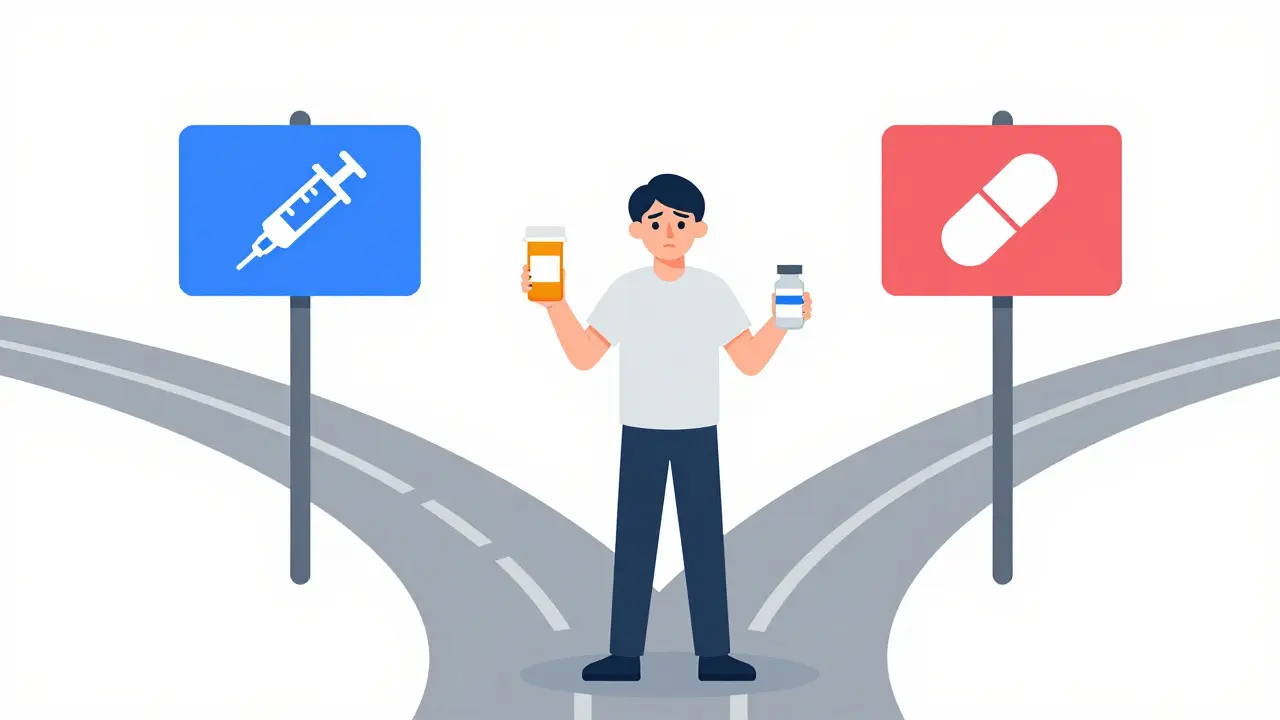
MedWatch vs VAERS Reporting Guide
What type of product caused the reaction?
Select the category that best describes what you received or used.
Vaccine
Flu shot, childhood immunizations, travel vaccines, COVID-19 vaccine
Drug
Prescription medications, over-the-counter drugs, supplements
Medical Device
Pacemakers, surgical tools, implants, diagnostic equipment
Biologic (Non-Vaccine)
Blood products, gene therapies, cellular therapies
Food/Cosmetics
Food additives, contaminated food, cosmetics, tobacco products
Not Sure
I'm not certain which category applies to my situation
Describe the adverse event
Help us understand the severity and timing of your reaction.
Who are you in this situation?
This helps us provide the most relevant guidance for your reporting process.
Patient/Consumer
I experienced the reaction myself
Caregiver/Family Member
Reporting on behalf of someone else
Healthcare Provider
Doctor, nurse, pharmacist, etc.
Manufacturer/Company
Representing the product manufacturer
Key Information About Your Report
Direct Links to Report
💡 Pro Tips for Your Report
You just took a new prescription or got a flu shot, and now you’re feeling something unexpected. Maybe it’s a rash, maybe it’s severe fatigue, or perhaps something more serious. Your first instinct might be to report it online. But which system do you use? If you pick the wrong one, your report could get lost in the bureaucratic shuffle, delaying vital safety checks.
This is where the confusion between MedWatch and VAERS comes in. Both are federal systems designed to catch problems with medical products after they hit the market. But they handle completely different things. Mixing them up is like trying to return a book to the grocery store-it just won’t work.
Understanding the difference isn't just about filling out forms correctly; it's about ensuring that real safety signals reach the right experts at the Centers for Disease Control and Prevention (CDC) and the Food and Drug Administration (FDA). Let’s break down exactly what goes where, why it matters, and how these systems actually protect public health.
The Golden Rule: Vaccines Go to VAERS, Everything Else Goes to MedWatch
The simplest way to remember this is by product type. The U.S. government splits post-market surveillance into two main buckets based on what caused the issue.
VAERS (Vaccine Adverse Event Reporting System) is exclusively for vaccines. If your reaction happened after receiving any immunization-whether it was a childhood shot, a travel vaccine, or an annual flu jab-the report belongs here. VAERS is a joint program run by both the CDC and the FDA. It was created specifically because vaccines are administered to healthy people, often children, so even rare side effects need intense scrutiny.
MedWatch (FDA Safety Information and Adverse Event Reporting Program) covers everything else. This includes prescription drugs, over-the-counter medications, medical devices (like pacemakers or surgical tools), food additives, cosmetics, and tobacco products. If you had a bad reaction to a pill, a patch, or a piece of equipment, you file through MedWatch.
Here is the critical mistake many people make: submitting a vaccine report to MedWatch. The FDA explicitly states that vaccine adverse events should not go through MedWatch. If you do, the data gets routed incorrectly, slowing down the detection of potential patterns. Always check the label. Is it a vaccine? Use VAERS. Is it a drug or device? Use MedWatch.
How VAERS Works: Speed Over Certainty
VAERS operates as a passive surveillance system. "Passive" means it waits for reports to come in rather than actively tracking every patient who gets vaccinated. Anyone can submit a report-a doctor, a nurse, a parent, or the patient themselves. You don’t need proof that the vaccine caused the problem. In fact, you are encouraged to report even if you are unsure.
Why such a low bar for entry? Because speed is the priority. The goal of VAERS is early warning. It looks for "safety signals." Imagine if dozens of people reported the same rare heart condition within weeks of getting a specific vaccine lot. VAERS would flag this pattern immediately. This allows the CDC and FDA to investigate further before a larger crisis develops.
When you fill out a VAERS form, you provide details like:
- The specific vaccine(s) received, including manufacturer and lot number.
- The date of vaccination and the date symptoms started.
- Your medical history and current medications.
- Details of the adverse event itself.
However, there is a major caveat you must understand. A report in VAERS does not mean the vaccine caused the injury. The system collects raw data. It cannot prove causation. People get sick for many reasons. They might have caught a virus from someone else at the clinic, or had an underlying condition flare up. VAERS captures the coincidence, but it doesn’t judge the cause. That judgment comes later, through deeper studies.

How MedWatch Works: Broad Scope for Medical Products
MedWatch is the FDA’s broader net. While VAERS focuses solely on biologics (vaccines), MedWatch handles the massive world of pharmaceuticals and devices. It routes reports to different centers within the FDA depending on the product:
- CDER (Center for Drug Evaluation and Research): Handles prescription and OTC drugs.
- CDRH (Center for Devices and Radiological Health): Handles medical devices.
- CBER (Center for Biologics Evaluation and Research): Handles non-vaccine biologics like blood products.
- CFSAN (Center for Food Safety and Applied Nutrition): Handles food and cosmetics.
Like VAERS, MedWatch accepts voluntary reports from consumers and healthcare professionals. But it also has strict mandatory reporting requirements for manufacturers. If a drug company knows their product caused a serious injury or death, they are legally required to report it to the FDA via MedWatch pathways. This creates a layer of structured data that complements the voluntary consumer reports.
For the average person, using MedWatch feels similar to VAERS. You describe the product, the reaction, and the timeline. The key difference is the destination. Your report goes to the experts who specialize in that specific type of product. A reaction to a hip implant goes to device specialists, while a reaction to a statin goes to drug specialists.
| Feature | VAERS | MedWatch |
|---|---|---|
| Primary Focus | Vaccines only | Drugs, devices, food, cosmetics, tobacco |
| Managed By | CDC and FDA | FDA only |
| Who Can Report? | Anyone (public, providers, manufacturers) | Anyone (public, providers, manufacturers) |
| Mandatory Reporting? | Yes, for manufacturers and some providers | Yes, for manufacturers and user facilities |
| Proves Causation? | No (identifies signals only) | No (identifies signals only) |
| Best For | Rapid detection of vaccine safety issues | Monitoring broad medical product safety |
The Limitations: Why These Systems Aren't Perfect
To trust these systems, you have to understand their flaws. Both VAERS and MedWatch are "passive" systems. This leads to significant underreporting. Experts estimate that less than one percent of actual adverse events are ever reported to VAERS. MedWatch likely suffers from similar gaps, though exact numbers vary by product type.
Why so low? Most side effects are mild-a sore arm, a headache-and people assume they aren't worth reporting. Others forget. Some don't know the systems exist. This means the data in these databases is not a complete picture of reality. It is a snapshot of what people *chose* to report.
There is also the issue of bias. Reports can be incomplete, inaccurate, or influenced by recent news stories. If a media outlet runs a scary story about a vaccine, VAERS reports might spike temporarily, not because the vaccine changed, but because people are more alert to symptoms. Conversely, if a drug has been on the market for decades, people might stop reporting common side effects, making the drug look safer than it is. This is known as "reporting fatigue."
Because of these limitations, neither system can scientifically prove that a product caused an injury. The CDC and FDA are very clear about this. They will not give you medical advice based on a VAERS report. They will not tell you if your vaccine gave you diabetes. They simply collect the data to see if patterns emerge across thousands of cases.
What Happens After You Report?
Once your report enters the system, it doesn't just sit there. Analysts review it for completeness. If you reported a serious event-like hospitalization or death-staff may contact you or your doctor for more records. This follow-up helps clarify the timeline and context.
If VAERS detects a cluster of similar reports, it triggers a deeper investigation. The CDC uses other tools to verify the signal. For example, they might use the Vaccine Safety Datalink (VSD), which links electronic health records from millions of patients. Unlike VAERS, VSD has a denominator-it knows exactly how many people got the vaccine and how many didn’t. This allows researchers to calculate actual risk rates. If VSD confirms the signal found in VAERS, then regulators can take action, such as updating labels, restricting use, or in rare cases, removing the product from the market.
MedWatch follows a similar path. Signals identified in MedWatch data lead to reviews by the relevant FDA Center. They may request more data from manufacturers, conduct clinical trials, or issue public warnings. The process is slower for drugs and devices because the landscape is so much wider, but the principle is the same: spot the pattern, verify with better data, act if necessary.
Practical Tips for Reporting
If you decide to report a side effect, here is how to make your report useful:
- Be Specific: Don't just say "I felt bad." Describe the symptom, when it started, and how long it lasted.
- Include Product Details: For drugs, include the name, dose, and manufacturer. For vaccines, include the lot number if you have it (it’s on the box or paperwork).
- List Other Factors: Mention other medications you take, existing health conditions, or recent illnesses. This helps analysts rule out other causes.
- Don't Wait: Report as soon as possible. Memory fades, and details matter.
- Use the Right Portal: Double-check. Vaccine? VAERS. Pill/Device? MedWatch.
Reporting is a civic duty. It helps keep everyone safe. Even if your reaction was minor, it contributes to the big picture. And remember, reporting does not mean you are suing anyone or claiming compensation. It simply adds a data point to the national safety net.
Can I sue the government if my report is accepted?
No. Submitting a report to VAERS or MedWatch is not a claim for compensation. These systems are for safety monitoring only. If you believe you were injured by a vaccine, you may need to look into the National Vaccine Injury Compensation Program (VICP), which is a separate legal process. For drug injuries, personal injury lawsuits against manufacturers are handled through the court system, not the FDA.
Does reporting a side effect affect my medical insurance?
No. Your report goes directly to the FDA or CDC. It is not shared with your insurance company, employer, or private doctor without your consent. The data is anonymized for statistical analysis. Reporting a side effect will not raise your premiums or affect your coverage.
What if I’m not sure if the vaccine or drug caused my reaction?
You should still report it. Both VAERS and MedWatch encourage reports even when causation is uncertain. The purpose is to detect patterns. If many people report the same symptom after using the same product, it becomes a signal worth investigating, regardless of whether every individual case was definitely caused by the product.
Is there a deadline for reporting?
While there is no strict legal deadline for voluntary consumer reports, it is best to report as soon as possible. Accurate details fade over time. For manufacturers and healthcare providers, there are strict regulatory deadlines (often 15 days for serious events) to report to the FDA, but individuals are encouraged to report whenever they feel a reaction is notable.
Can I track what happens to my report?
Generally, no. Once submitted, your report becomes part of the federal database. You will not receive updates on its status or how it influences policy. However, you can search the public portions of the VAERS and MedWatch databases to see aggregated data and trends, though individual reports remain confidential.
Written by Felix Greendale
View all posts by: Felix Greendale