
Most parents assume that if their child isn't complaining about blurry vision, their eyes are doing just fine. Here is the problem: children rarely complain because they don't actually know what "normal" vision looks like. If a child is born with a lazy eye or a refractive error, their brain simply accepts a blurry image as the standard. By the time a parent notices a squint or a child struggles in school, the window for the most effective treatment may have already closed.
The goal of pediatric vision screening is a systematic process used to identify children with vision disorders or those at risk of permanent visual impairment. Detecting issues like amblyopia (lazy eye) or strabismus (misaligned eyes) before age 7 is the critical threshold. After this age, the brain's plasticity decreases, making it much harder to "train" the eye to see correctly.
Why Timing Matters: The Race Against the Clock
There is a massive difference between catching a vision problem at age 3 versus age 8. According to the Vision in Preschoolers (VIP) study, timely intervention can improve visual acuity in 80-95% of children with amblyopia if caught before age 5. Once a child hits age 8, that success rate plummets to between 10% and 50%.
Why is this happening? The visual system is incredibly flexible in early childhood. If one eye is weaker, the brain can be encouraged to use it again through patching or drops. However, once the critical period of development ends, the neural pathways are essentially locked in. This is why the U.S. Preventive Services Task Force (USPSTF) recommends that every child be screened at least once between the ages of 3 and 5.
Screening Methods by Age Group
You can't exactly ask a six-month-old to read a chart. Because of this, the tools used for screening change as the child grows. Professionals use a tiered approach to ensure no child slips through the cracks.
- Infants (Newborn to 6 Months): The primary tool is the red reflex test. A doctor uses an ophthalmoscope to check the reflection of light from the back of the eye. If the reflection is absent or asymmetrical, it could signal cataracts or retinoblastoma.
- Toddlers (6 Months to 3 Years): This phase combines the red reflex test with an external examination of the eyelids and a check on ocular motility (how the eyes move together).
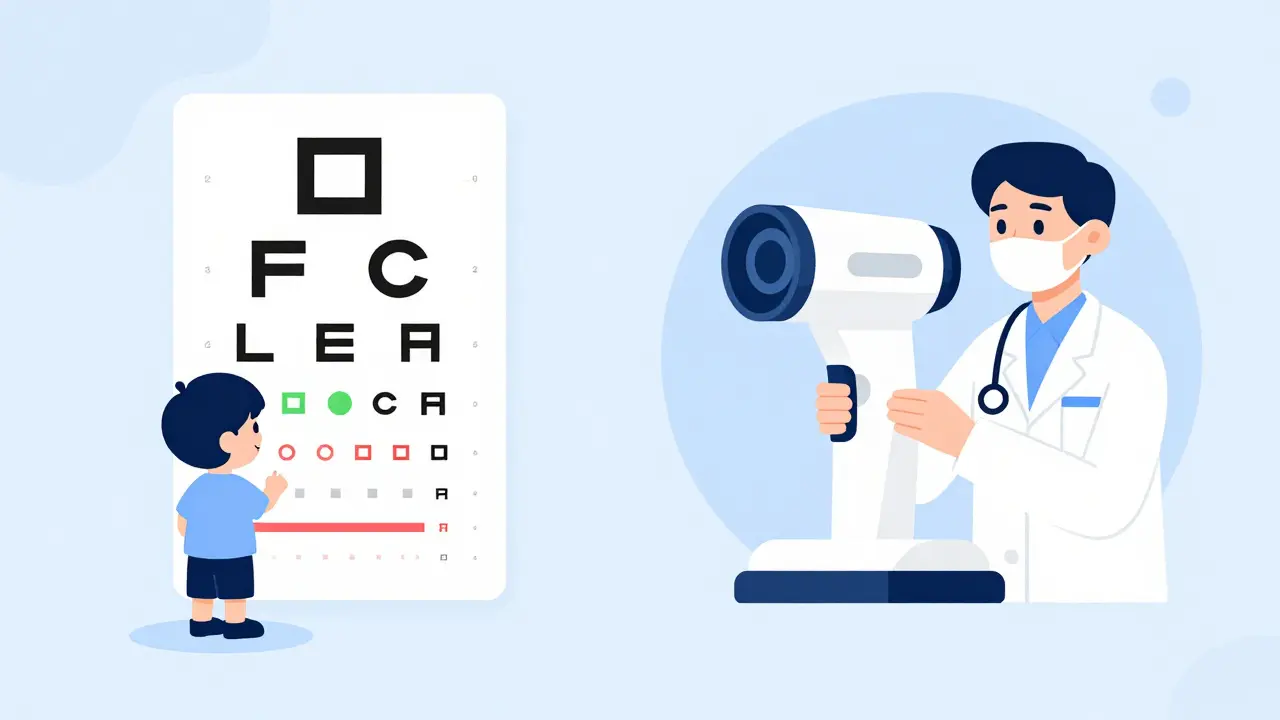
- Preschoolers and School-Aged (3+ Years): This is where visual acuity testing begins. Children are asked to identify shapes or letters on a chart from a specific distance-usually 10 feet for distance vision and about 15 inches for near vision.
| Feature | Optotype-Based (Charts) | Instrument-Based (Scanners) |
|---|---|---|
| Best For | Cooperative children aged 5+ | Toddlers and uncooperative children |
| Time per Child | 3-5 minutes | 1-2 minutes |
| Main Limitation | Requires cognitive cooperation | Potential for false positives (small errors) |
| Examples | Sloan letters, LEA symbols | Retinomax, blinq’ scanner |
The Shift Toward Instrument-Based Screening
Traditional eye charts are the "gold standard" for older kids, but they fail frequently with 3-year-olds. In fact, 10-25% of children in that age group simply cannot or will not cooperate with the test. This is where autorefractors and photoscreeners come into play.
Modern devices like the blinq’ scanner use AI to detect issues almost instantly. These tools are highly efficient and often provide a higher positive predictive value for children aged 3-4 compared to traditional charts. Instead of asking a child to identify a letter, the machine measures how light reflects off the retina to determine the prescription and alignment of the eyes.
When Should a Child Be Referred to a Specialist?
Screening is not a diagnosis; it is a filter. The goal is to decide who needs a comprehensive exam by a pediatric ophthalmologist. Most screening programs use a "critical line" pass/fail system. If a child cannot identify the majority of symbols on a specific line, they are referred for further testing.
The benchmarks generally follow this pattern:
- Age 3: Must pass the 20/50 line.
- Age 4: Must pass the 20/40 line.
- Age 5+: Must pass the 20/32 (or 20/30 for Snellen) line.
Beyond the numbers, there are "red flags" that warrant an immediate referral regardless of the chart score. These include a noticeably turned eye, white spots in the pupil (leukocoria), or a child who constantly tilts their head to see objects more clearly.
Common Pitfalls in Pediatric Screening
Not all screenings are created equal. Poorly executed tests can lead to false positives, causing unnecessary parental anxiety and wasted medical resources. One common issue is incorrect distance measurement; if the child is too close to the chart, they may pass a test they should have failed. Poor illumination of the eye chart is another frequent error, affecting roughly 25% of screening events in some clinical settings.
Healthcare providers must also be aware of the "learning curve." It typically takes a few hours of specialized training to become proficient in pediatric screening. Ongoing quality checks are essential to ensure that the person administering the test isn't subconsciously "helping" the child pass by gesturing or giving hints.
The Bigger Picture: Public Health and Equity
Vision screening is one of the most cost-effective public health interventions available. The benefit-cost ratio is estimated at 3.7:1, potentially saving over $1.2 billion in lifetime costs associated with untreated vision loss. However, this benefit isn't reaching everyone equally. Data shows that Hispanic and Black children are 20-30% less likely to receive these recommended screenings.
To close this gap, many states have mandated school-entry screenings. While 38 states have these laws, the standards vary. The move toward integrating AI-powered screeners into primary care and school settings is a major step toward making early detection a universal reality rather than a luxury of those with access to specialized pediatric clinics.
At what age should my child have their first vision screening?
Screening begins at birth with the red reflex test. However, the most critical window for detecting amblyopia and refractive errors is between ages 3 and 5. The USPSTF recommends at least one formal screening during this period to ensure any issues are treated while the brain is still plastic.
What is the difference between a vision screening and a comprehensive eye exam?
A screening is a quick test designed to identify "at-risk" children; it is not a full diagnosis. A comprehensive eye exam is performed by an optometrist or ophthalmologist and involves dilating the pupils to check the health of the retina and precise measurements to determine the exact prescription needed.
Can a "lazy eye" (amblyopia) be fixed if caught late?
While it is much harder to treat after age 7, it is not impossible. However, the success rate drops significantly from 80-95% (before age 5) to 10-50% (after age 8). This is why early detection is so vital-the brain's ability to rewire itself is strongest in early childhood.
Are those handheld AI scanners as accurate as the charts?
For very young children (ages 2-4), instrument-based scanners are often more reliable because they don't require the child to understand instructions or stay focused. For children aged 5 and up, traditional optotype charts (like Sloan letters) remain the gold standard for measuring precise visual acuity.
What should I do if my child fails a school vision screening?
Do not panic, as screenings can produce false positives. The next step is to schedule a comprehensive pediatric eye exam with a specialist. This will determine if the failure was due to a temporary issue, a need for glasses, or a condition like strabismus that requires medical intervention.
Next Steps for Parents and Caregivers
If your child is between 3 and 5 and hasn't had a formal vision screen, bring it up at your next well-child visit. Ask your pediatrician if they use instrument-based screening or traditional charts. If your child is already in school, check with the school nurse to see when the last screening occurred and ask for the specific results-not just a "pass/fail"-so you can track any changes over time.


Written by Felix Greendale
View all posts by: Felix Greendale