

Clozapine ANC Monitoring Calculator
Calculate Your Monitoring Schedule
Enter how long you've been taking clozapine to see your current monitoring requirements.
Key Monitoring Facts
Based on FDA guidelines:
- Week 1-6 Weekly ANC testing
- Month 6-12 Biweekly ANC testing
- After 12 months Monthly ANC testing
- Critical ANC below 1,500/μL requires immediate medical attention
- Ethnic Variations Patients with benign ethnic neutropenia use 1,000/μL threshold
Before February 24, 2025, getting clozapine wasn’t just about a prescription. If you or someone you know was taking clozapine for treatment-resistant schizophrenia, you were stuck in a complex system: mandatory blood tests, certified doctors, enrolled pharmacies, and monthly paperwork. The FDA’s Risk Evaluation and Mitigation Strategy (REMS) made sure every step was tracked. But that’s all over now. The FDA officially removed the mandatory REMS program for clozapine - and for many patients, that means faster access, less bureaucracy, and fewer barriers to a drug that works when nothing else does.
Why Clozapine Matters
Clozapine isn’t just another antipsychotic. It’s the most effective one for people with treatment-resistant schizophrenia - the kind that doesn’t respond to at least two other medications. Studies show it helps 30% to 50% of those patients, compared to just 10% to 15% with other drugs. For many, it’s the only thing that reduces hallucinations, keeps them out of the hospital, and even lowers suicide risk. Yet, despite its power, only about 12% of eligible patients in the U.S. were taking it in 2024. Why? Because the REMS program made it too hard to get.What Was the Clozapine REMS Program?
When clozapine was first approved in 1989, the FDA noticed a serious danger: severe neutropenia, a drop in white blood cells that can lead to life-threatening infections. In 2005, they put in place a monitoring system. By 2015, it became a full REMS program - a legally enforced safety protocol. Here’s how it worked:- Doctors had to be certified through the Clozapine REMS website.
- Pharmacies had to be certified too - and many small pharmacies couldn’t keep up.
- Patients had to enroll and submit monthly paperwork proving their Absolute Neutrophil Count (ANC) was safe.
- Pharmacies couldn’t fill the prescription unless they got confirmation from the REMS system.
- After November 2021, even phone checks weren’t allowed - you had to log in online or call a center.
This system wasn’t just inconvenient. It added 10 to 15 minutes per prescription at the pharmacy. Clinics spent an average of 3.2 hours a week just on paperwork. Patients waited days or weeks. The National Alliance on Mental Illness found that about 30% of people trying to start clozapine faced delays because of REMS. Some never got the drug at all.
ANC Monitoring: The Core of the Old System
The heart of the REMS program was the ANC blood test. This measures the number of neutrophils - a type of white blood cell critical for fighting infection. The FDA required strict timing:- Baseline ANC before starting clozapine.
- Weekly tests for the first 6 months.
- Every two weeks from 6 to 12 months.
- Monthly after 12 months.
These numbers weren’t random. Research from the Department of Veterans Affairs and the FDA’s own studies showed the biggest risk happens in the first 18 weeks. But the danger doesn’t vanish after that. That’s why monitoring was lifelong - even if less frequent. The cutoff for safe ANC was 1,500/μL for most people, and 1,000/μL for those with benign ethnic neutropenia - a common, harmless condition in some populations.

The Big Change: REMS Removed in February 2025
On February 24, 2025, the FDA announced the mandatory REMS program for clozapine was gone. No more certification. No more monthly forms. No more pharmacy hold-ups. Prescribers can now write the prescription. Pharmacies can fill it. Patients can get it - without jumping through regulatory hoops.This wasn’t a snap decision. The FDA spent over a year reviewing real-world data:
- They analyzed over 100,000 patient records from the Sentinel System.
- They worked with the VA, Brigham and Women’s Hospital, and other health systems.
- They looked at adverse event reports and prescribing patterns.
The findings? Healthcare providers were already doing the right thing. Even without the REMS system, 95% of prescribers continued following the recommended ANC monitoring schedule. The risk of severe neutropenia is still real - about 0.8% of patients experience it - but doctors are aware, and they’re monitoring.
What’s Different Now?
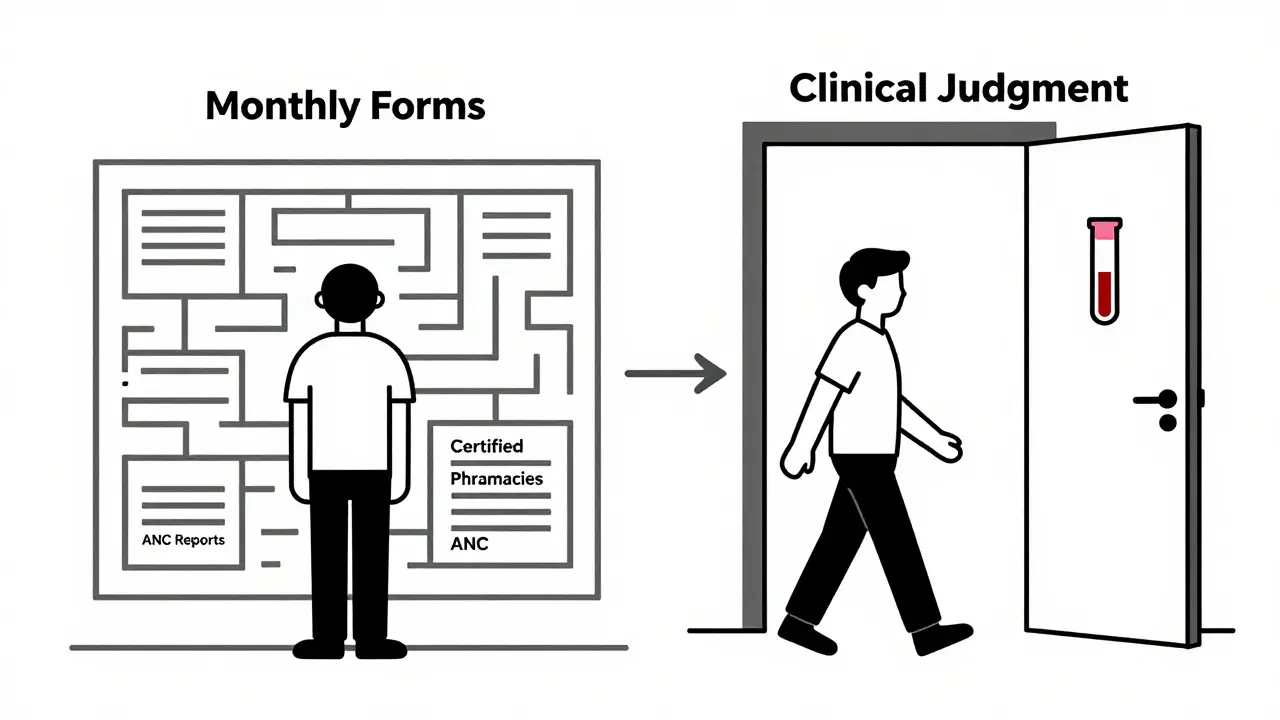
Here’s what changed:- No more REMS certification for doctors or pharmacies.
- No more patient enrollment in the REMS database.
- No more monthly ANC reports sent to a federal system.
- Pharmacies can dispense clozapine without checking the REMS portal.
But here’s what didn’t change:
- The boxed warning about severe neutropenia is still on every clozapine label.
- Doctors are still strongly advised to check ANC before starting and follow the same timeline: weekly for 6 months, biweekly for months 6-12, monthly after that.
- Patients still need to get their blood tested - just not to report it to the FDA.
The shift means the responsibility is back where it should be: between the doctor and the patient. No middleman. No bureaucracy. Just clinical judgment.
Why This Matters for Patients and Providers
For patients, this is huge. Many were stuck in limbo - their symptoms didn’t improve, but they couldn’t get the one drug proven to help. Some gave up. Others waited months. Now, the process is faster. A psychiatrist can say, “You’re a candidate for clozapine,” and the pharmacy can fill it within days.For providers, it’s a relief. No more logging into a separate portal. No more training renewals every two years. No more staff time spent on paperwork. A 2023 study in Schizophrenia Bulletin found clinics without dedicated REMS coordinators were nearly four times less likely to start clozapine. That barrier is gone.
Industry experts predict a 25% to 30% rise in clozapine use over the next two years. Anthem’s Provider News estimates that means thousands more people will get access to a drug that can change their lives.
What About Safety?
Some worry: without the REMS system, will people stop getting blood tests? The answer is no - and here’s why.- Clozapine’s label still carries the same black box warning.
- Professional guidelines from the American Society of Health-System Pharmacists (ASHPS) are updating their 2025 recommendations to reinforce ANC monitoring.
- Studies show doctors are already monitoring at high rates - even without enforcement.
- The FDA will keep watching through the Sentinel System, which tracks real-time drug safety across millions of patients.
Severe neutropenia is rare, but it’s serious. That’s why monitoring continues. But now, it’s based on medical judgment, not government rules.
What Comes Next?
Manufacturers like Novartis are updating clozapine prescribing information to remove all references to the REMS program. By mid-2025, all labels will reflect the change. Training materials for doctors and pharmacists are being revised. The American Psychiatric Association and APNA have already endorsed the move, calling it a win for patient access and clinical autonomy.The bigger picture? This could set a precedent. Other drugs with burdensome REMS programs - like thalidomide or isotretinoin - still require strict controls. But clozapine’s case shows that when providers are educated and risks are well understood, mandatory reporting systems may no longer be needed. The goal isn’t to remove safety - it’s to remove unnecessary barriers to life-saving care.
Is clozapine still dangerous because of neutropenia?
Yes, the risk of severe neutropenia still exists, especially in the first 6 months of treatment. About 0.8% of patients experience it, according to VA data. But the FDA and medical experts agree that this risk is well-managed through regular blood tests - not mandatory federal reporting. The boxed warning remains on all clozapine labels.
Do I still need to get my ANC checked if I’m on clozapine?
Yes. Even though the REMS program is gone, your doctor should still check your ANC before you start, then weekly for the first 6 months, biweekly from 6 to 12 months, and monthly after that. These are still standard medical recommendations. Skipping tests increases your risk.
Can my pharmacy still refuse to fill my clozapine prescription?
They can’t refuse because of REMS anymore - there’s no system to check. But they might still refuse if you don’t have a current ANC result, if your prescription is outdated, or if they have internal policies. Always bring your latest blood test results to the pharmacy.
Do I need to re-enroll or recertify for clozapine now?
No. The Clozapine REMS enrollment and certification systems were shut down as of February 24, 2025. You don’t need to do anything to stay in the program - because there is no longer a mandatory program. Your doctor will handle your care based on clinical guidelines.
Why did the FDA remove REMS if the risk is still there?
Because doctors were already doing the right thing. The FDA reviewed data from over 100,000 patients and found that 95% of prescribers were following ANC monitoring guidelines even without the REMS system. The program added heavy administrative burdens without improving safety. Removing it reduces delays and increases access - while keeping safety in the hands of clinicians, not bureaucracy.


Written by Felix Greendale
View all posts by: Felix Greendale