
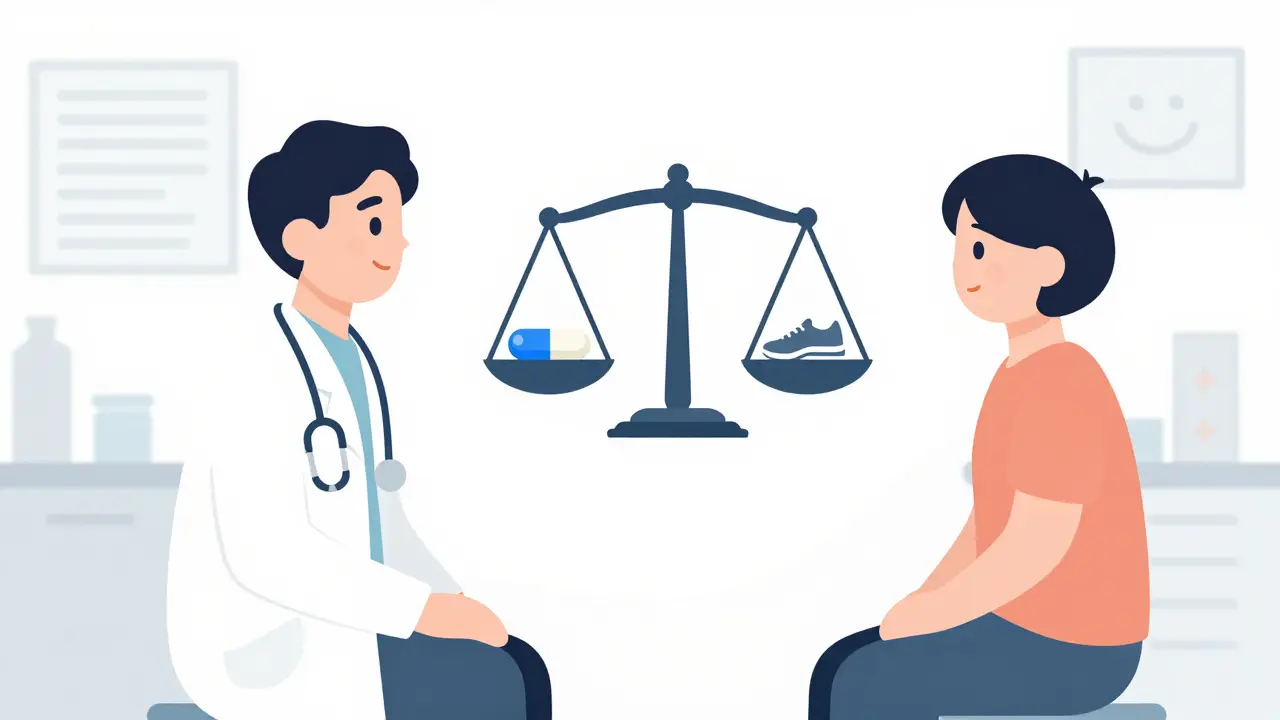
SDM Script Generator: Trade-Off Conversations
How to use: Select the clinical goal below to see a professionally phrased script. Replace the bracketed text [...] with your specific medication details to transform a clinical statistic into a patient-centered conversation.
Suggested Script:
Most of us are used to the old-school 'informed consent' model: the doctor tells the patient the risks, the patient nods, and the prescription is signed. But that approach often fails because it treats side effects as checkboxes rather than lived experiences. When patients feel the 'burden of treatment'-the actual impact on their daily activities-outweighs the benefit, they stop taking their meds. In fact, for medications like statins, up to 86% of patients cite side effect concerns as the reason they quit. SDM scripts change this by giving clinicians a structured way to ask, 'What is a deal-breaker for you?'
| Feature | Traditional Informed Consent | SDM Scripts for Trade-Offs |
|---|---|---|
| Goal | Legal protection / Risk disclosure | Alignment with patient values |
| Communication | One-way (Doctor to Patient) | Two-way dialogue |
| Risk Framing | Vague terms ("Common", "Rare") | Absolute numbers ("1 in 10") |
| Patient Role | Passive recipient | Active partner in the choice |
| Outcome | Potential for decision regret | Higher treatment adherence |
The Frameworks: Moving from Theory to Conversation
If you're wondering how to actually start these conversations without sounding like a robot, there are two primary models used in modern clinics. The first is the SHARE Approach, developed by the Agency for Healthcare Research and Quality (AHRQ). It is a five-step process designed to move a patient from uncertainty to a confident decision.
- Seek: Find a moment to let the patient know they have a choice.
- Help: Compare options clearly. Don't just say "Drug A is better," but explain the trade-off.
- Assess: Ask about their values. For a marathon runner, joint pain is a bigger deal than for someone else.
- Reach: Decide together based on the evidence and the patient's priorities.
- Evaluate: Check back in to see if the decision is still working for them.
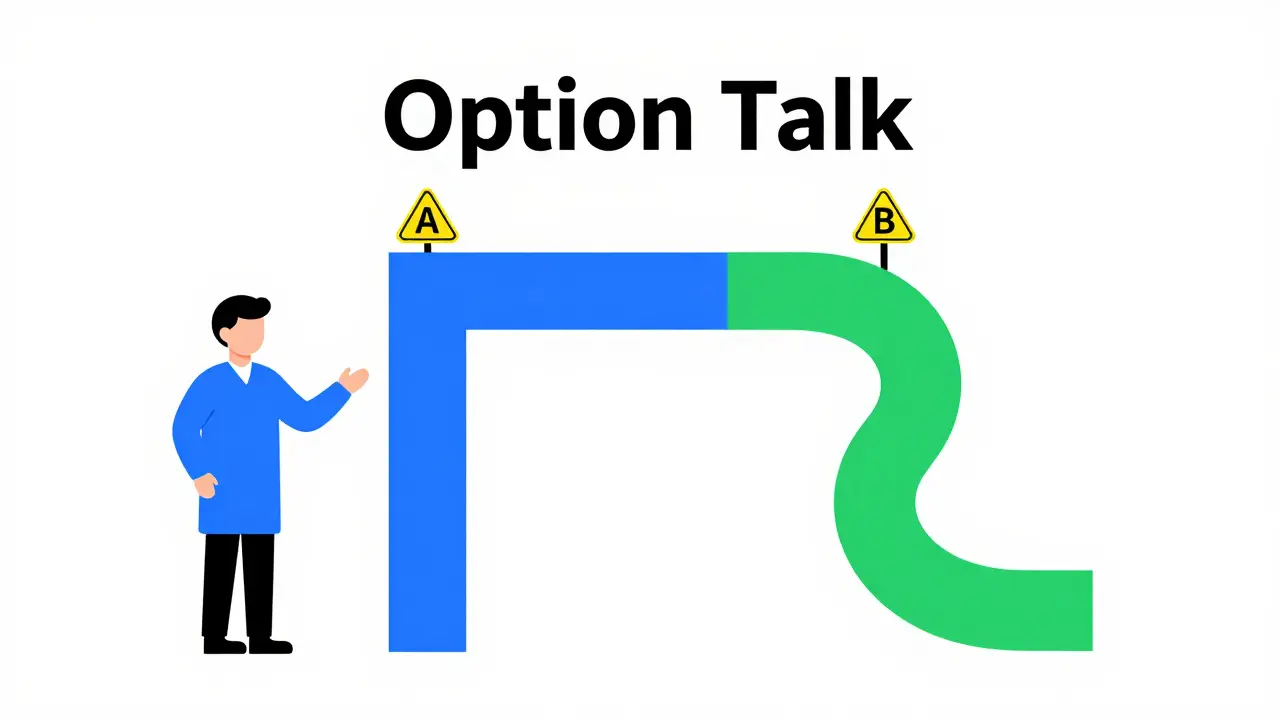
Then there is the Three-Talk Model. This is often preferred in complex settings like oncology because it focuses heavily on "Option Talk." Instead of using vague adjectives, this model requires precise numerical framing. For example, instead of saying a side effect is "uncommon," a clinician would say, "This happens in 1 out of 10 people, meaning 9 out of 10 will not experience it." Research shows this absolute risk framing improves patient comprehension by about 37% compared to relative risk descriptions.
Practical Scripts for the Exam Room
The magic of SDM isn't in the theory, but in the specific words used. The goal is to bridge the gap between a clinical statistic and a patient's daily reality. Here are a few ways to phrase these trade-offs based on the AHRQ toolkit:
- Identifying Priorities: "Some people are particularly concerned about weight gain, while others worry more about fatigue. Which of these would impact your daily life the most?"
- Exploring Deal-Breakers: "If we choose this medication, there is a 15% chance of nausea. On a scale of 1 to 10, how much of a deal-breaker would that be for your work schedule?"
- Framing the Trade-Off: "We can choose the medication that is slightly more effective but has a higher risk of insomnia, or this one that is very safe but might take longer to show results. Which sounds more manageable for you?"
By shifting the focus to "treatment burden"-the actual impact on daily life-clinicians can reduce decision regret. Interestingly, about 42% of patient regret in chronic medication management stems from this burden, not the clinical failure of the drug itself.
Why It Actually Works: The Data
Skeptics often argue that these conversations take too long. Time-motion studies at Scripps Health show that comprehensive SDM adds about 7.3 minutes to a consultation. However, that investment pays off. The same data shows a 22% reduction in follow-up visits specifically related to side effect management. When the patient feels they "owned" the decision, they are more likely to persevere through mild side effects because they expected them.
In more severe cases, like chemotherapy, the impact is even more pronounced. A study in JAMA Internal Medicine found a 29% reduction in treatment discontinuation when structured SDM scripts were used instead of standard consent. Essentially, when patients aren't blindsided by a side effect, they don't panic and quit the treatment.

Avoiding the "Checkbox" Trap
There is a danger in using scripts: the risk of sounding clinical and detached. Dr. Robert Kaplan from UCLA has pointed out that over-structuring the dialogue can make it feel like a checkbox exercise. If a doctor reads a script without listening, patient satisfaction can actually drop by 19%.
The key is personalization. The script is a map, not a teleprompter. The most successful implementations, like those at Kaiser Permanente, combine these scripts with visual aids. Using color-coded risk charts to show the probability of a side effect leads to a 41% higher satisfaction rate because it removes the guesswork from the conversation.
Implementation and Future Trends
For clinicians looking to adopt this, the learning curve is real. Data from the Massachusetts General Hospital Health Decision Sciences Center suggests that it takes about 12 supervised patient interactions to reach proficiency in these conversations. It's also helpful to use pre-visit education materials-like short videos explaining side effect probabilities-which can shave about 3.2 minutes off the actual in-person conversation.
Looking ahead, the technology is catching up. We are seeing the integration of SDM modules directly into Epic Systems EHRs, allowing doctors to pull up condition-specific scripts with one click. There is even movement toward AI-powered tools that can analyze the nuance of a patient's speech to identify "unspoken" concerns about side effects that the patient might be too shy to bring up directly.
Does Shared Decision-Making take too much time in a busy clinic?
While it adds an average of 7.3 minutes to the initial visit, it typically reduces the number of follow-up calls and visits related to side effect complaints by 22%, saving time in the long run.
What is the difference between absolute risk and relative risk in SDM?
Relative risk often sounds more dramatic (e.g., "reduces risk by 50%"), while absolute risk is more transparent (e.g., "reduces the chance of an event from 2% to 1%"). SDM scripts prioritize absolute risk because it significantly improves patient comprehension and realistic expectations.
Can SDM be used in emergency rooms?
It is much more difficult in acute settings. Research shows only a 12% feasibility rate for complete SDM processes during emergency episodes due to time constraints and the urgency of the medical need.
Which model is better: SHARE or the Three-Talk Model?
It depends on the setting. The SHARE Approach is excellent for general healthcare and chronic disease, while the Three-Talk Model is often more effective in high-complexity areas like oncology due to its focus on precise numerical framing.
How do I document an SDM encounter for reimbursement?
Under CPT codes 96170-96171, physicians should record the specific side effect concerns expressed by the patient and the shared understanding of the risk thresholds they agreed upon in the electronic health record.


Written by Felix Greendale
View all posts by: Felix Greendale