
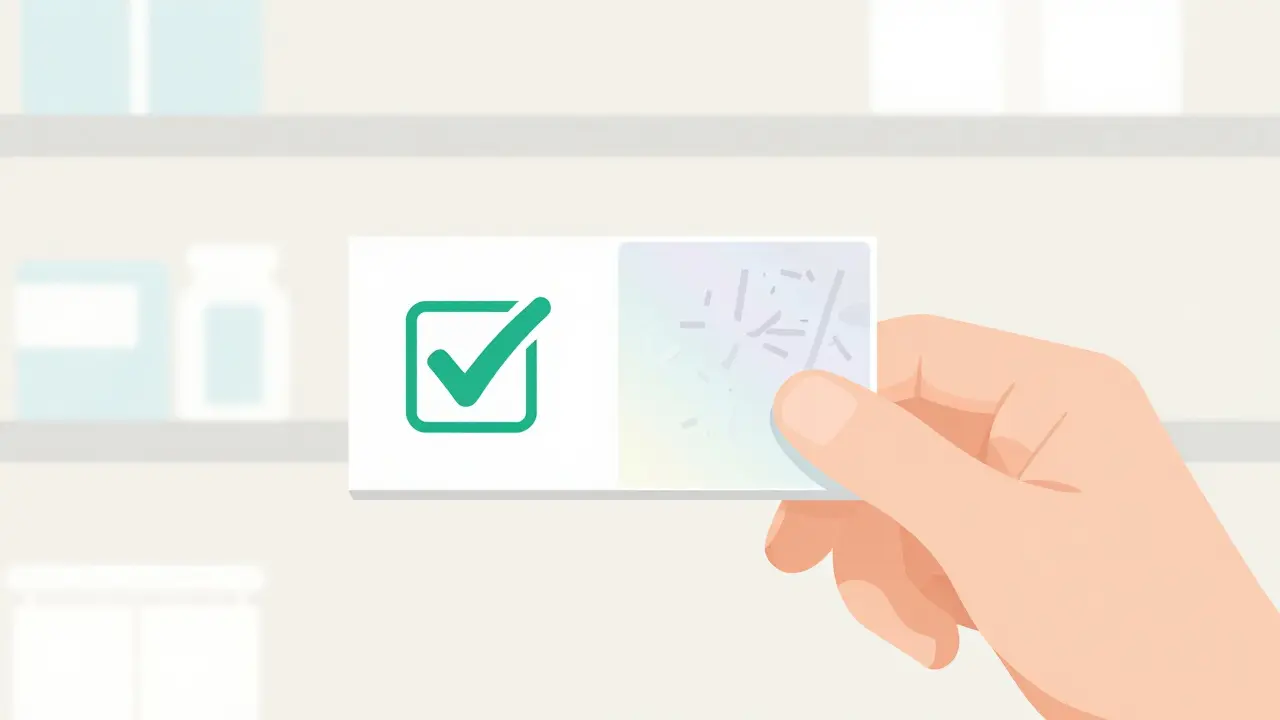
Imagine picking up your monthly prescription for blood pressure medication, only to discover later that the pills were just chalk and sugar. It sounds like a movie plot, but it is a terrifying reality for millions of people worldwide. According to the World Health Organization (WHO), counterfeit medicines represent up to 10% of the global pharmaceutical market, with rates climbing to 30% in some developing regions. For generic drugs, which make up the bulk of prescriptions in many countries, the risk feels higher because manufacturers often invest less in high-tech security features compared to big-name brands. This article breaks down exactly how you can verify the authenticity of generic medicines using packaging clues, labeling checks, and modern technology.
The Hidden Risks of Fake Generics
Why does this matter so much? It’s not just about losing money on a useless purchase. Substandard and falsified (SF) medicines pose severe public health risks. The FDA warns that these fakes can lead to treatment failure, drug resistance, or even death. A stark example occurred in 2012 when a meningitis outbreak in the United States was linked to contaminated steroid injections from a compounding pharmacy. While that case involved compounded drugs, it highlights how supply chain vulnerabilities allow bad actors to slip through. Generic medicines are particularly vulnerable because they pass through 5-7 distribution points on average, compared to just 3-4 for branded products. Each handoff is an opportunity for counterfeits to enter the mix.
Many patients assume that if a box looks right, the medicine inside is safe. That assumption is dangerous. Modern counterfeiters replicate packaging with 90-95% accuracy, according to INTERPOL’s 2023 Operation Pangea report. They mimic fonts, colors, and even holograms. To stay safe, you need to look beyond the surface and understand the layers of security built into legitimate pharmaceutical packaging.
Overt Security Features: What You Can See
The first line of defense is what experts call "overt" features-security elements visible to the naked eye without special tools. These are designed for quick consumer inspection. Here is what to look for:
- Color-Shift Inks: Legitimate packaging often uses Optically Variable Ink (OVI). When you tilt the box, the color should change distinctly. For instance, Pfizer’s Viagra packaging shifts from green to blue. If the color stays flat or changes muddy shades, be suspicious.
- Holograms: Authentic holograms have depth and micro-texts ranging from 50 to 100 micrometers. Counterfeit versions often look flat or pixelated. Hold the box up to the light; genuine holograms usually display complex patterns that shift smoothly.
- Specialized Printing: Look for crisp edges and consistent font spacing. A Reddit user noted spotting fake Nexium generics because the expiration date font was slightly off-a subtle clue that saved them from harm.
While overt features are easy to check, they are also the easiest to copy. Sophisticated counterfeiters can replicate holograms with 80-90% accuracy. Therefore, relying solely on visual inspection is risky. You need to dig deeper.
Covert Features: Tools for Closer Inspection
If the overt features raise doubts, move to "covert" features. These require simple tools but offer much higher security. Pharmacies and informed consumers use these methods regularly.
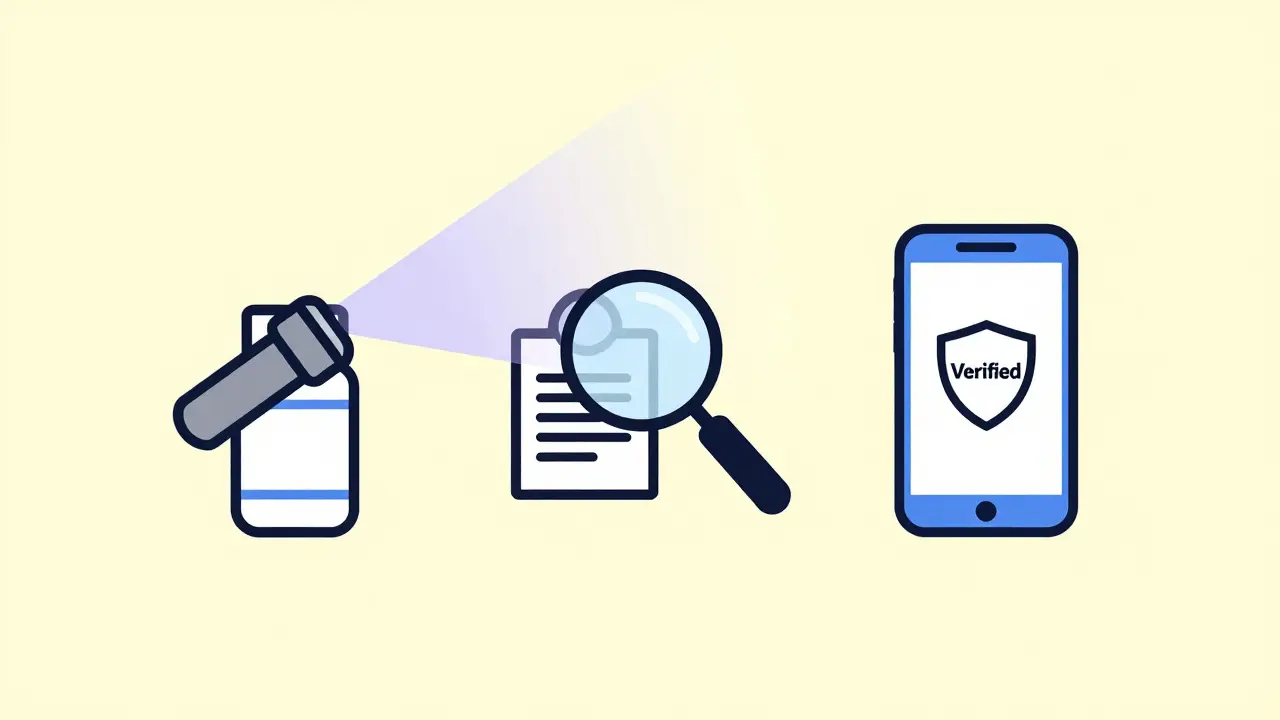
- UV Light Check: Many legitimate drugs use UV-sensitive inks invisible under normal light but glowing under 365nm ultraviolet light. Johnson & Johnson has used this on Tylenol packaging since 2015. A cheap UV flashlight costs around $20 and can reveal hidden logos or text.
- Magnification: Use a magnifying glass to inspect micro-printing. Genuine labels often contain tiny text that appears as a solid line to the naked eye but reads clearly under 10x magnification.
- Chemical Taggants: Some manufacturers embed markers like Lumilink® UV, detectable with handheld readers costing $200-$500. These are more common in professional settings but highlight the level of scrutiny applied to high-risk medications.
Dr. Maria Kresal, Chief Scientific Officer at the European Directorate for the Quality of Medicines, cautions that over-reliance on packaging alone is dangerous. Even with covert features, modern fakes can mimic visual cues. This is why technological verification becomes essential.
Track-and-Trace Systems: Digital Verification
The most robust layer of protection involves digital tracking. Regulations like the U.S. Drug Supply Chain Security Act (DSCSA) and the EU Falsified Medicines Directive (FMD) mandate unique serial numbers for every package. These systems use GS1 standards to create a digital trail from manufacturer to patient.
| Technology | Function | Pros | Cons |
|---|---|---|---|
| 2D Data Matrix Code | Unique serial number per pack | High security, cryptographic authentication | Requires smartphone app or scanner |
| RFID Tags | Radio-frequency identification | Fast bulk scanning, hard to clone | Higher cost, requires specialized readers |
| QR Codes | Link to verification database | Easy for consumers to scan | Easier to forge than data matrix codes |
In the EU, the European Medicines Verification System (EMVS) processes over 2.5 billion requests annually with 99.998% uptime. However, challenges persist. Trustpilot reviews of apps like MediMark show that barcode scanning fails 40-50% of the time with generics due to inconsistent serialization. Always ensure you are using official manufacturer apps or verified pharmacy portals rather than third-party scanners.
Spectroscopy: The Gold Standard for Analysis
When packaging and labels pass all tests, the final arbiter is the chemical composition itself. Spectroscopic devices analyze the molecular structure of the pill without destroying it. This is where expertise shines.
Near-Infrared (NIR) spectroscopy is considered the gold standard for field verification. Devices like the Thermo Fisher TruScan RM weigh just 1.4 kg and provide results in 10-30 seconds. They detect coating defects and moisture variations that indicate counterfeits. A study in the American Pharmaceutical Review found NIR achieves 92-97% accuracy for identifying fake Plavix generics. Raman spectroscopy, such as the B&W Tek NanoRam, offers similar precision but struggles with dark-colored tablets due to fluorescence interference.
For individual consumers, buying these devices ($15,000-$50,000) isn’t practical. But knowing their existence helps you trust pharmacies that use them. Pharmacists using Bruker handheld spectrometers reported 94% satisfaction in a 2023 survey, noting that these tools detected fake metformin that looked identical to authentic products.
Practical Steps for Consumers
You don’t need a lab to protect yourself. Follow these actionable steps every time you pick up generic medication:
- Inspect the Seal: Ensure the tamper-evident seal is intact. Any breakage or re-adhesion is a red flag.
- Check the Font: Compare the printing quality with previous boxes. Blurry text or uneven ink distribution suggests poor manufacturing.
- Verify Online: Use the manufacturer’s official website or app to scan serial numbers. Do not rely on unofficial QR codes printed by third parties.
- Ask Your Pharmacist: If something looks off, ask your pharmacist to verify it. They have access to reference samples and verification tools.
- Report Suspicious Items: Contact local regulatory bodies like the FDA or EMA if you suspect a counterfeit. Reporting helps shut down illegal supply chains.
Remember, Dr. Paul Newton from Oxford University notes that while track-and-trace systems have reduced wholesale counterfeiting in regulated markets by 65-75%, they remain inaccessible in many areas. Vigilance is your best ally.
Future Trends in Verification
The fight against counterfeit drugs is evolving. By 2028, Gartner forecasts that 70% of pharmaceutical verification will use AI-enhanced multi-method approaches. Blockchain pilots by the FDA have already achieved 99.2% accuracy in tracking products across four distribution tiers. Additionally, the 2024 update to the EU FMD requires all generic medicines to implement 2D data matrix codes with cryptographic authentication by January 1, 2025. These advancements promise a safer future, but until global standards harmonize, individual awareness remains critical.
Can I verify generic medicines at home?
Yes, you can perform basic checks at home. Inspect packaging for tampering, check holograms for depth, and use a UV flashlight to look for hidden inks. For definitive proof, consult your pharmacist or use official manufacturer verification apps.
Why are generic medicines more prone to counterfeiting?
Generics often have lower profit margins, leading manufacturers to invest less in high-cost security features. Additionally, they pass through more distribution points (5-7 vs. 3-4 for brands), creating more opportunities for infiltration.
What is the most reliable way to detect a fake pill?
Is spectroscopy available for personal use?
Spectroscopic devices like NIR scanners are highly accurate but expensive ($15,000-$50,000). They are primarily used by pharmacies and labs. Individuals should rely on visual checks and professional verification instead.
How do track-and-trace systems work?
Each package gets a unique serial number (e.g., 2D data matrix code). Scanning this code links to a central database that confirms the product’s journey from manufacturer to pharmacy, ensuring no duplicates exist.
What should I do if I suspect my medicine is fake?
Stop taking the medication immediately. Contact your pharmacist for verification. If confirmed fake, report it to local health authorities like the FDA or EMA to help prevent others from being harmed.
Written by Felix Greendale
View all posts by: Felix Greendale